Flexopus News
2024-01-17

Introducing: Smart Analytics
Data instead of installments! The article presents Flexopus' new Smart Analytics, which enable companies to precisely analyze their office workload. Learn how to optimize rental costs, make efficient use of space and make well-founded decisions for your hybrid work model through data-based insights. The future of office management is measurable.

Table of contents
In today's society, the collection of data is tainted with a certain amount of mistrust - and rightly so. Almost everyone is told that personal data must be protected to prevent unauthorised sale and malicious use. However, it is important to recognise that collecting data does not always have to be a negative thing. In fact, when data is used responsibly, it can be a powerful tool for solving various problems. Flexopus has introduced the Smart Analytics feature in response to these considerations.
Analytics and Statistics
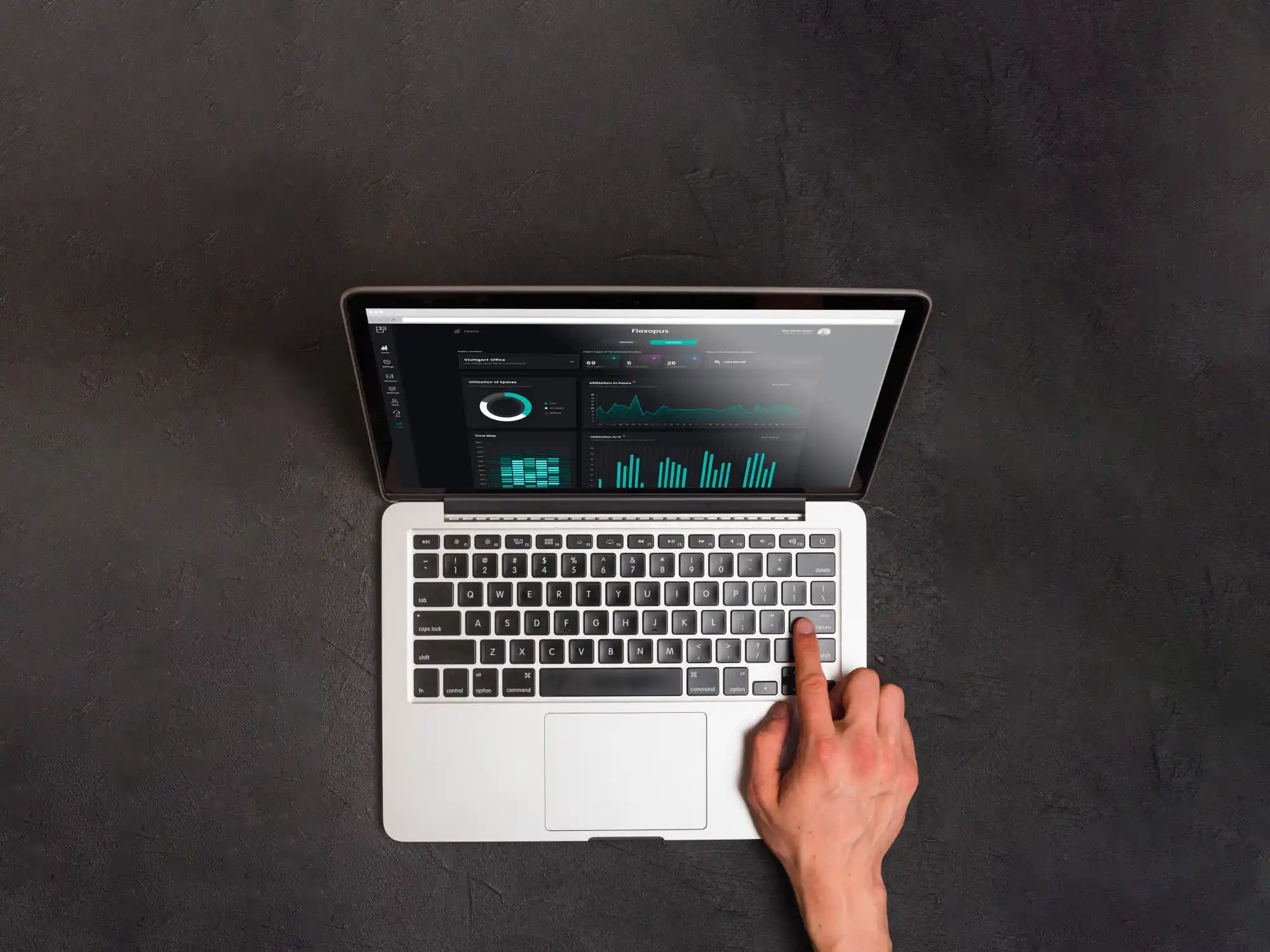
All of the data collected with Flexopus' hot desk booking software is easily accessible to you in a user-friendly format in the Smart Analytics Dashboard. Analysing this historical data at property level provides you with insights into the utilisation of workstations, meeting rooms and parking spaces. Among other things, this tool helps you to identify the most popular properties and determine the days of the week with the highest booking activity. The platform also generates statistics on booking frequency across months, days and hours, providing a comprehensive insight into utilization patterns.
Select a specific time period for a customized analysis and determine target values for office occupancy. This feature allows you to make informed decisions about downsizing or expansion based on property utilization. Smart Analytics can also help you assess the capacity of meeting rooms based on their size to improve planning. Use the timecard feature to calculate peak booking times at both the building and floor level, broken down by hour. Overall, these analyses help to effectively optimise your workspace.
Flexopus Smart Analytics also allows you to export the data to ensure more in-depth analyses. With this function, all data collected by Flexopus can be exported in CSV format and further processed in Microsoft Excel, Google Sheets or the data processing program of your choice.
The Heatmap
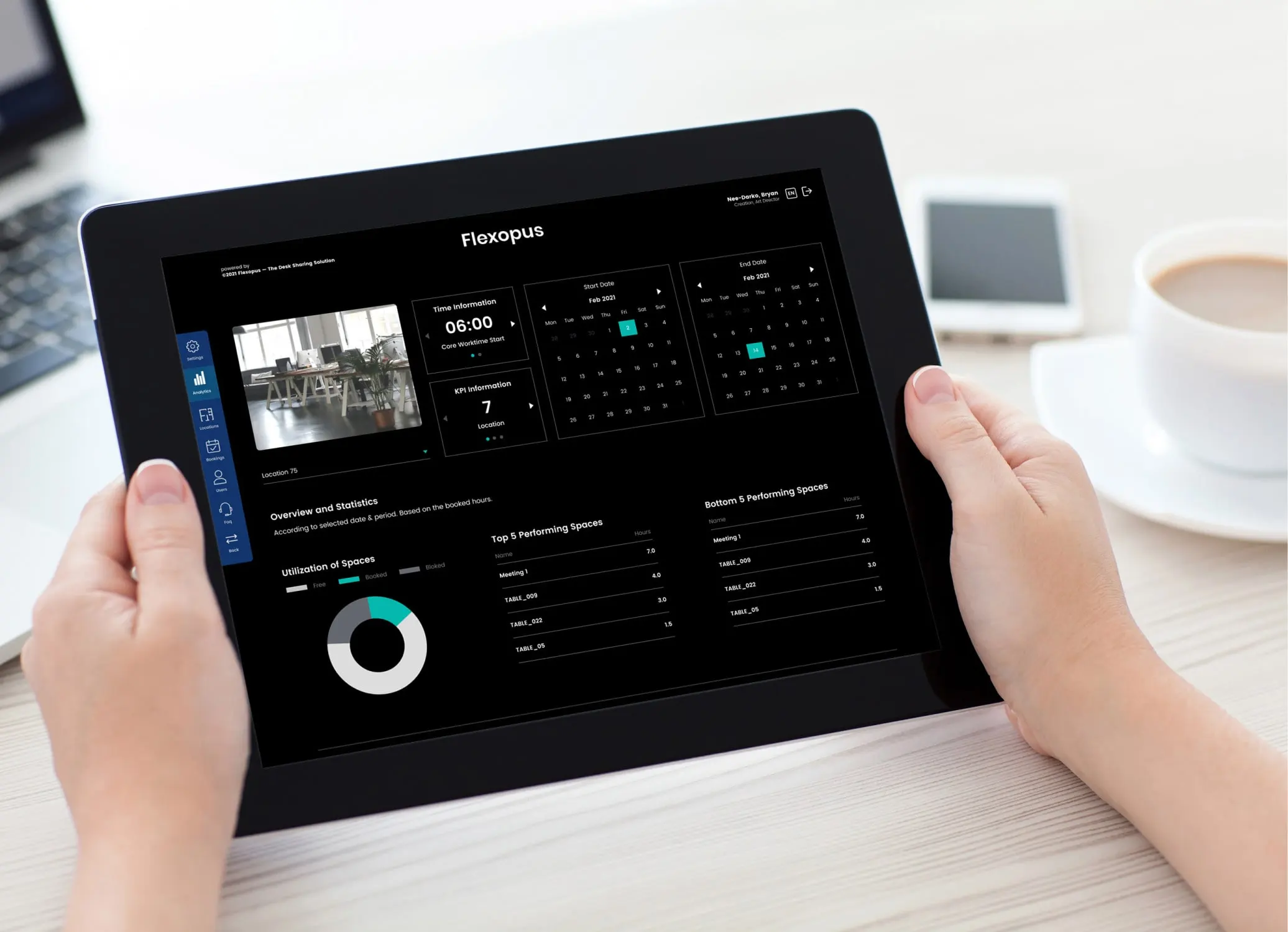
Flexopus Smart Analytics also includes a handy heat map that provides a comprehensive overview of property utilisation. Identify at a glance properties with low activity and those that are in high demand. Using this feature gives you valuable insights for informed decision making. For example, if the area near the kitchenette is gaining popularity, this indicates a potential need for more desks. On the other hand, you can also consider a smaller office space if many desks are not booked at all or only very rarely. So this particular statistic goes even deeper than the building and floor plan metrics and analyses the properties within a selected floor plan. The heat map provides a breakdown of the collected data by time, building and floor plan and provides nuanced insights for strategic decision-making. Further, it calculates the analysis of each property based on the sum of hours, average and percentage utilization (both daily and in minutes).
User Statistics
As an optional setting and with the express consent of your works council in particular, analyses can be carried out at user level. In this way, office or car park bookings, meeting room reservations and the attendance frequency of certain employees in the office and mobile office can be tracked. However, analyses at user level are deactivated by default in order to prioritize data protection.
Is your data safe?
Protecting data and using it as a tool for better decision-making is a critical balance in today's digital landscape. To meet our data protection and data security standards, the Flexopus standard configuration does not analyze personal data within the dashboard. Analyses are carried out exclusively at object level and thus meet the highest compliance requirements of data protection officers or works councils.
Conclusion
The analysis of historical data serves as a basis for well-founded decisions in the area of organizational and office improvements. Smart Analytics is a helpful tool that serves as a catalyst for implementing strategic cost-cutting measures, increasing employee satisfaction and improving the efficiency of daily office operations. By utilizing this feature, you gain the foresight needed to make proactive adjustments that enable a workspace that not only meets current needs, but also anticipates and adapts to the dynamic demands of the future.
The most important questions summarized
How do smart analytics help companies manage their office space more efficiently?

Smart analytics transform anonymous booking data into valuable insights. Companies can see exactly which days of the week are the busiest and which zones or workplaces are barely used. This transparency makes it possible to identify unused space and, if necessary, to reduce rental space or convert rooms into more attractive formats (e.g. meeting zones). Instead of vague estimates, decisions about office size and design are now based on hard facts, which saves costs and increases efficiency in the long term.
What are the benefits of real-time data analysis for managing hybrid teams?
Planning security is crucial for managing hybrid teams. By analyzing booking trends, it is possible to predict when the office will be busy. This helps with coordinating team events or managing attendance times. The data also shows whether the hybrid models offered are accepted by the workforce. In this way, the company can react agilely to the needs of employees and ensure that the office infrastructure is always optimally tailored to current team dynamics and the hybrid way of working.
How is employee data protection ensured when using Smart Analytics?
Data protection is a top priority at Flexopus. Smart analytics work with aggregated and anonymized data. This means that the focus is on using resources (tables, rooms, parking spaces) and not on monitoring individual people. The goal is to optimize the work environment, not to monitor performance. By strictly following GDPR guidelines, companies can gain valuable insights while protecting everyone's privacy at all times. This creates trust and acceptance for digital transformation.
Last updated:
2026-10-04
.svg)

_11zon.jpg)