Flexopus News
2026-07-30
New at Flexopus: Secure, passwordless sign-in with Passkey Login
Flexopus now supports passkeys for the web application. Users can log in without a traditional password using fingerprint, facial recognition, device PIN, or security keys. This speeds up the login process and provides better protection against phishing. Administrators can enable this feature centrally, and users can then set up their passkey in their profile.

Table of contents
Passwords have been a part of our daily digital work life for decades. They must be created, stored, and entered regularly. At the same time, stolen or reused credentials continue to pose a significant security risk.
With the new passkey login, Flexopus offers a simpler and more secure way to sign in to the web version. Users verify their identity directly via their device without having to enter a Flexopus password every time they log in. This makes logging in more convenient and reduces the risk posed by stolen or reused passwords.
What is a passkey login?
A passkey is a digital sign-in key that replaces a traditional password. The login is verified using a method already set up on the device, such as:
- Fingerprint,
- Facial recognition,
- Device PIN,
- Pattern, or
- a compatible hardware security key.
Technically, passkeys are based on a cryptographic key pair. The private key is protected by the authenticator being used, while a public key is stored with the respective service for verification. The private key is never transmitted to the service.
Passkeys are also bound to the specific service or its domain. This means the sign-in key cannot simply be used on a look-alike phishing site. The FIDO Alliance therefore describes passkeys as phishing-resistant by design.
Passkey login now available in Flexopus
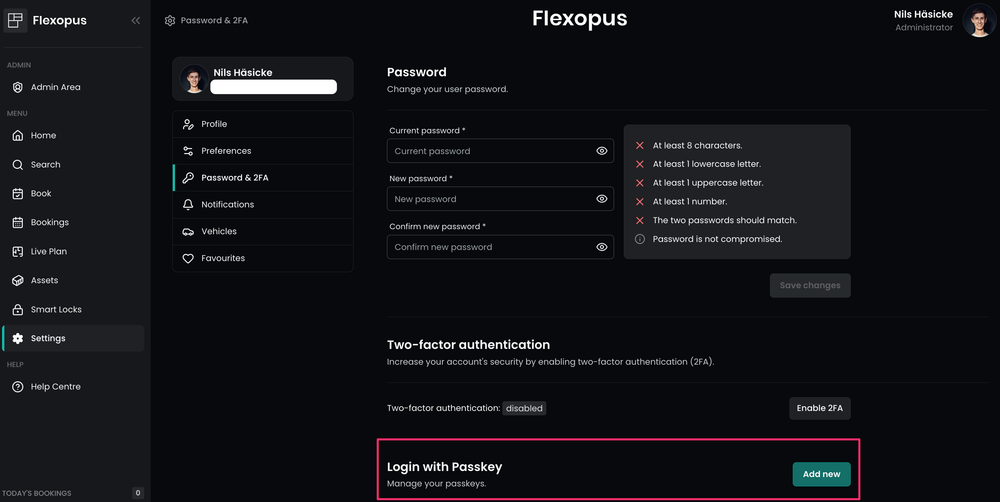
As of Flexopus version 2.52.0 , passkey login is available for the web application. Administrators can enable this feature centrally. Once enabled, users can create a passkey for their account in their personal profile settings.
After setup, an additional option for logging in with a passkey will appear on the Flexopus sign-in page. This adds a highly convenient, passwordless access method to the previously configured login options.
Support for the Flexopus mobile apps is planned for a later date. Currently, the new feature applies to the web version only.
How the passkey login works in Flexopus
Once set up, logging in takes just a few steps:
- Flexopus users open the sign-in page of their Flexopus instance.
- Select the option to sign in with a passkey.
- The device will prompt you for the configured verification.
- The sign-in is authorized via methods such as fingerprint, facial recognition, device PIN, or a security key.
- Flexopus verifies the cryptographic proof and signs the user in.
A Flexopus password does not need to be entered during this process.
The exact appearance of the sign-in process may vary depending on the operating system, browser, device, and passkey provider used. However, the fundamental process remains the same: the user confirms the sign-in via a trusted authenticator.
What are the benefits of passkey login?
Faster sign-in
Passwords often need to be copied from a password manager or entered manually. With passkeys, you generally just use the same method you already use to unlock your device.
This makes accessing Flexopus faster, especially in your daily work routine. Employees can reserve a desk, check a booking, or open the live plan without any significant interruptions.
No more forgotten passwords for daily logins
Complex passwords are hard to remember. Simple passwords, on the other hand, are easier to guess and are frequently reused across multiple services.
When signing in with a passkey, users do not need to enter or memorize a Flexopus password. This reduces common issues like typos, forgotten credentials, and unnecessary password resets.
.jpg)
Better protection against phishing
In a classic phishing attack, users are directed to a fake login page and prompted to enter their password.
Passkeys are bound to the domain for which they were created. Therefore, a passkey set up for your Flexopus instance cannot be easily used on a foreign or malicious domain.
Protection against stolen password data
Passkeys do not require a shared password for authentication. Instead, the device uses a private key to cryptographically prove that the user possesses the correct passkey.
The server stores the public part of the key pair. This can be used to verify a login, but it does not allow for the reconstruction of the private key.
Convenience and security without an extra step
Users often perceive security as an added burden. Passkeys combine both goals: logging in becomes easier while simultaneously reducing the typical risks associated with password-based methods.
For companies, this means that a more secure login method does not necessarily have to lead to a more complicated user experience.
Enable Passkey login for admins
Before employees in your company can create a passkey for Flexopus, the feature must be enabled by an administrator.
The setting can be found in the Flexopus admin area under:
Admin area → Global settings → Authentication → Passkey login
Once enabled, users can set up a passkey in their profile independently.
When enabling the feature, admins should briefly inform their employees about the following points:
- why the company is offering passkeys,
- which devices and authentication methods can be used,
- how to set up a passkey,
- which alternative login method is available in case of issues,
- who users should contact if they change devices or lose their security key.
A short internal guide can significantly speed up the adoption of the new feature.
Set up your personal passkey in Flexopus
Once an administrator has enabled Passkey login, employees can create their personal passkey.
The corresponding setting can be found in the user profile under:
Profile settings → Password & 2FA
You can add a new passkey there. Your device or browser will then guide you through the setup process. Once registration is complete, the additional passkey option will be available on the login page.
The specific steps may vary depending on your operating system and authenticator. Typically, creation is confirmed using your device PIN, a fingerprint, or facial recognition.
What happens when you switch devices?
How a passkey is made available on a new device depends on the passkey provider you are using.
Synchronized passkeys can be made available across multiple devices via the associated credential or password manager. Other passkeys are strictly tied to a specific device or a physical security key. The FIDO Alliance distinguishes between synchronized and device-bound passkeys accordingly.
Companies should therefore continue to provide at least one regulated recovery or alternative login process. Users should also check their passkeys in their Flexopus profile settings and remove any access keys that are no longer needed.
Which companies are suitable for passkey login?
Passkey login offers benefits for companies of all sizes. It is particularly relevant for organizations that:
- want to simplify the login process for their employees,
- want to reduce their reliance on passwords,
- want to offer their users a phishing-resistant login option,
- have many daily or recurring Flexopus logins,
- manage external or decentralized users without a shared SSO system ,
- want to integrate modern authentication methods into their IT strategy.
Uncomplicated login is also helpful in the hybrid workday. Employees access Flexopus from various locations to book desks, rooms, or parking spaces, for example. A quick login reduces unnecessary hurdles.
The most important questions summarized
What is the new Passkey login in Flexopus?

Passkey login enables passwordless authentication for the Flexopus web application. Instead of a password, users verify their login via fingerprint, facial recognition, device PIN, or a compatible security key. This makes access faster and reduces the typical risks associated with traditional passwords.
What are the advantages of passkeys over passwords?
Passkeys are more convenient and offer better protection against phishing. Users no longer need to remember passwords or enter them repeatedly. The private key remains on the device or with the authenticator being used and is never transmitted to Flexopus. This significantly reduces the risks associated with stolen or reused passwords, as well as those entered on fraudulent websites.
How do I set up Passkey login in Flexopus?
Administrators can enable passkey login in the admin panel under global authentication settings. Once enabled, users can add a personal passkey in their profile settings under "Password & 2FA." After setup, the passkey will appear as an additional login option on the Flexopus login page.
Last updated:
2026-08-04
.svg)

.webp)