Desk sharing
2026-07-31
.jpg)
Desk Sharing with Excel: Why spreadsheets reach their limits in the hybrid office
Desk sharing via Excel is a simple entry-level solution, but it quickly reaches its limits in day-to-day operations. Double bookings, high maintenance requirements, a lack of reporting, and data privacy concerns make spreadsheets impractical as usage grows. Specialized desk sharing software provides greater transparency, security, and automation.

Table of contents
Many companies still organize their flexible workspaces using Microsoft Excel. While this is a practical solution to get started, it quickly leads to double bookings, high maintenance, and unresolved data privacy issues in long-term operation. This article shows how a desk sharing Excel template is structured, where its limitations lie, and what a desk sharing software does better.
Why desk sharing with Excel is so common
The transition from fixed to shared workspaces begins in most companies with a spreadsheet. One sheet per floor, desks in the rows, calendar days in the columns, plus a link on SharePoint. There are good reasons for this:
- The license is already available, so there are no additional costs.
- It requires no IT approval and no procurement process.
- Everyone in the company knows how to use Excel.
- Free templates can be found and customized in just a few minutes.
- For a single team with 15 desks, the model actually works.
As an interim solution, the spreadsheet is perfectly fine. It becomes difficult when the pilot project becomes a permanent state and more departments, floors, or locations are added.
How a desk sharing Excel template is typically structured
Common templates almost always follow the same pattern. A matrix maps workspaces against time periods; employees enter their names into the cells. Advanced versions supplement this with drop-down lists, conditional formatting for occupied desks, a separate sheet for each part of the building, and a legend for equipment features such as docking stations or height-adjustable desks.
This allows you to track which desk is occupied and who is using it. For everything else, you need team agreements, email reminders, and someone to keep the file up to date.
Where the Excel desk booking tool reaches its limits
Three problems occur most frequently:
1. Double bookings and blocked desks
Excel does not offer binding reservations. Anyone who has an older version of the file open can easily overwrite colleagues' entries when saving, and anyone who books a desk but then decides to work from home remains, holding the spot for the entire day because a check-in is missing. In practice, this leads to morning arguments and desks that are marked as occupied throughout the day, even though no one is there.
2. Lack of orientation within the building
The table lists a desk number. It doesn't show where desk 3.14 is actually located, whether it's by a window, or if your team is sitting in the same zone. As a result, new employees have to ask for help, while everyone else just books the same desk out of habit. The actual purpose of desk sharing—the flexible use of the entire space—remains unfulfilled.
3. Utilization is difficult to analyze
Desk sharing pays off based on the desk sharing ratio and the actual utilization of the space. Extracting these metrics from an Excel file is time-consuming, and the results are only as good as the entries themselves. Anyone making decisions about leased space or renovations based on this data is essentially working with estimates, thereby missing out on potential cost savings.
Data protection: the underestimated risk
Excel lists also reach their limits when it comes to data protection. Attendance records are often considered personal data. A spreadsheet that all employees at a location can view, which tracks who was in the office and when over several months, comes quite close to creating a movement profile. Excel offers no tiered role-based access control, automatic deletion periods, access logging, or privacy settings for individual employees.
This becomes a major issue, at the latest, when coordinating with the works council . Desk sharing software like Flexopus meets these requirements through permissions and roles, configurable visibility, and defined retention periods.
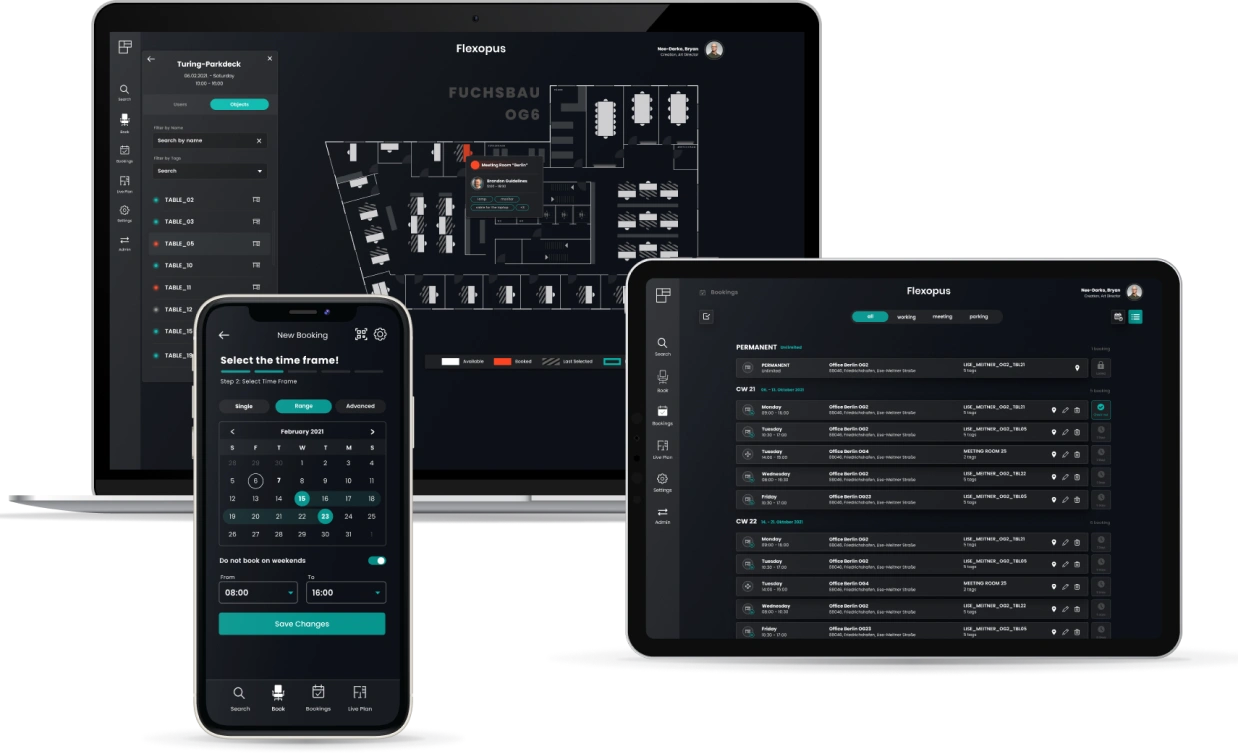
How Flexopus differs from an Excel desk booking tool
%20(1)%20(1)%20(1).jpg)
Flexopus is a workplace management platform used to book desks, meeting rooms, and parking spaces via interactive floor plans. The booking process consists of three steps: select a timeframe, choose a location, and book a workspace.
The most important differences compared to an Excel spreadsheet solution at a glance:
- interactive floor plans instead of desk lists, manageable via the integrated Floorplanner
- Live floor plans and favorites so employees can book near their teams
- Home zones and user groups for areas reserved for specific departments
- Flexible, fixed, and mobile workstations can be mapped simultaneously
- Smart Analytics with utilization rates per building, floor, and workstation
- Single sign-on via Microsoft Entra ID and calendar synchronization with Microsoft Exchange
- Booking directly in the Microsoft Teams app or on the go via iOS and Android apps
- Over 35 HRIS integrationsthat automatically sync absences
- Hosting on dedicated servers in Germany, ISO 27001:2022 certified by TÜV Rheinland
- Billing based on workstations rather than users, which directly impacts the cost of desk sharing software when the desk sharing ratio is greater than 1
When it makes sense to switch
Switching is generally recommended if at least one of the following applies:
- More than about 20 employees share flexible workspaces.
- There are multiple floors, buildings, or locations.
- Double bookings or blocked desks occur regularly.
- Maintaining the file is permanently the responsibility of a single person.
- You want to reduce office space but lack reliable occupancy data to do so.
- Data protection or employee representation requirements dictate how data is accessed and stored.
Bottom line: Desk sharing requires more than just a spreadsheet
A desk sharing Excel template is free and ready to use in an hour. There is no reason not to use one for an initial test. However, for long-term use, it leads to double bookings, high maintenance effort, and unresolved data protection issues.
Anyone who desk sharing operates on a permanent basis and wants to leverage it for space and cost benefits needs a system that reliably maps availability and makes usage measurable.
The most important questions summarized
When is Excel suitable for desk sharing?

Excel is primarily suited for small teams and pilot projects. A simple spreadsheet is quick to set up, incurs no additional licensing costs, and can be used without a major IT rollout. However, as soon as multiple teams, departments, or locations are involved, the maintenance effort and susceptibility to errors increase significantly.
What are the biggest limitations of using Excel for desk sharing?
Common issues include double bookings, blocked seats, missing floor plans, and time-consuming reporting. Furthermore, managing permissions, check-ins, mobile bookings, and automatic synchronization is either severely limited or impossible. As a result, Excel quickly becomes unmanageable in day-to-day operations.
When is it worth switching to desk sharing software?
Switching is particularly worthwhile for larger teams, multiple locations, or recurring booking issues. Specialized software also offers clear advantages when reliable occupancy data, data protection requirements, or automated processes become a priority. It reduces manual effort and makes the actual use of office space measurable.
Last updated:
2026-08-14
.svg)


.webp)