Desk sharing
2025-05-14
.webp)
Hybrid working and hot desking - modern working with Flexopus
The world of work is changing — are you ready? In this article, you'll learn how the combination of hybrid working and hot desking is revolutionizing your office. We'll show you how to increase space efficiency, promote team collaboration and at the same time create a modern corporate culture through flexible seating. Make your office a dynamic place of wellbeing for everyone!

Table of contents
Modern work models are becoming increasingly common. Gone are the days of working 8 hours a day at a fixed desk within a 40-hour week. Instead, new ways of working such as remote work, hybrid offices, co-working spaces and flexible work models are finding their place in our working world. The work environment as we've known it is constantly changing.
With all this flexibility and freedom, one thing is particularly important: a good overview, seamless organization, and a common interface through which everything can be managed. Thanks to the Flexopus Hot Desking Software implementing these new ways of working is a breeze. Employees benefit from maximum flexibility, while companies can optimally utilize their office spaces and guarantee their maximum occupancy.
Hot Desking Meaning
The term Hot Desk (literally: hot desk) describes permanently occupied workstations that, due to their high utilization, are never "cold" or unused. The term is often used in connection with Desk Sharing and hybrid work, thus forming part of new work models.
Essentially, hot desking is about designing workstations so that they can be used by multiple people. The typical "personal workstation" is eliminated. The goal is that no employee sits at the same spot on consecutive days. This not only provides variety and encourages interaction among colleagues, but also supports the optimization of resource utilization in office spaces.
Every user should be able to independently occupy a workstation without prior communication. This not only ensures there are no complications in desk allocation but also supports work models such as remote work or home office.

Desk Sharing vs. Hot Desking
The terms Desk Sharing and Hot Desking essentially differ in their order and planning capability. While general Desk Sharing involves proactively distributing and organizing a certain quota of workstations, employees have free rein with Hot Desking.
Differences
Hot desking and desk sharing differ significantly in practice. With hot desking, each employee selects a workspace daily, thus gaining the highest possible degree of flexibility. Hot desking therefore represents a simplified form of desk sharing.
Desk sharing, on the other hand, focuses on the planning and distribution of available workspaces among all employees present on a given day. A suitable software is often utilized for this, which also provides insights into resource utilization and manages everything clearly via an interface.
Similarities
Hot desking is an essential part of desk sharing. The basic principle of being able to choose from a pool of available workspaces remains consistent in both models. This also applies to the idea of never occupying the same desk on two consecutive days.

Benefits of Hot Desking Software
Software for managing hot desking can not only simplify the transition to full desk sharing but also significantly contribute to a structured and organized workday. An effective hot desking software should include several features:
Workspace Booking
Workspace booking is the core function of hot desking software. It allows employees to easily and straightforwardly reserve their desired workspace. Bookings should be as granular as possible, including the date, time, and location of the workspace, as well as specific features like special equipment. The hot desking software should allow employees to book their workspace as needed and rebook at any time.
User Management
User management is highly important for hot desking software. Through this, all user data, such as booking behavior and office presence, is recorded. Administrators gain insight into this data and can thus optimize the use of the hot desking software and overall booking behavior.
Clear Layout
To successfully implement hot desking and desk sharing, a clear application design is essential. Simple workflows, intuitive operation, and a good overview allow booking and administration processes to be handled quickly, without encountering unnecessary obstacles.

Features of a Hot Desking App
Equipment Filters
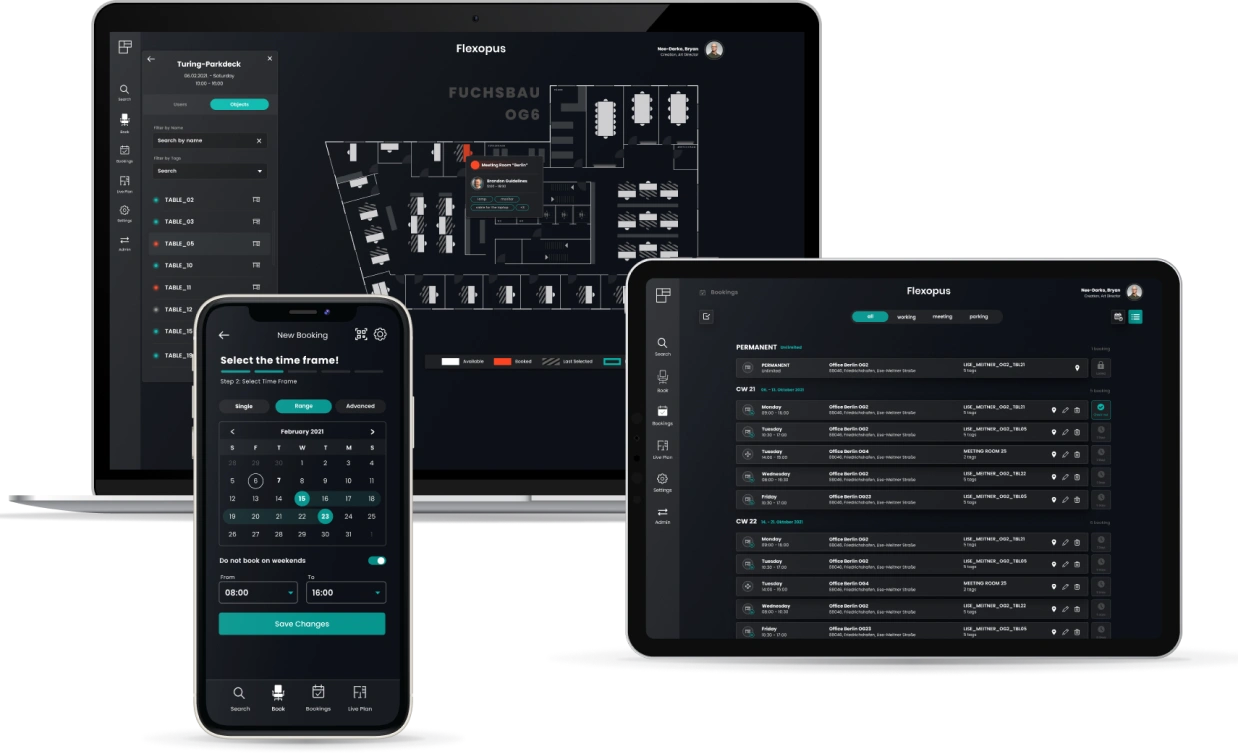
Categorize and filter your workspaces by desired equipment. Whether it's an ultra-wide monitor, a height-adjustable desk, or an ergonomic chair – you can easily and straightforwardly book at a glance.
User Groups
Thanks to the extensive user group management , it can be granularly determined who can book where. This allows for addressing the permissions of teams and groups, as well as those of each individual user.
Interactive Maps
Using the interactive Live Plan, you can view occupancy status, equipment features, and who your neighbors are. Additionally, a workspace, meeting room, or parking spot can be booked directly with a click.
Real-time Overview
In addition to a simple attendance list the Live Plan also shows who is currently present and which desk has been booked for what time. This makes spontaneous visits easy.
QR Code Booking
Using QR codes attached to the workspace, bookings can be made easily. A camera scan takes you directly to the app, where you can create a new booking or edit an existing one.
Set Favorites
The favorites feature allows users to be marked. The favorites overview shows at a glance who is sitting where and when, and you can also make a quick booking nearby.
Check-in Function
The optional check-in function requires app confirmation for every booking that is taken up. This way, bookings not checked into are deleted and workspaces are released again.

Hot Desking with Flexopus
With Flexopus hot desking becomes simple and straightforward. Employees can choose their workspace daily as needed, without being tied to a fixed desk. Flexopus enables easy reservation of workspaces that can be flexibly booked according to needs and equipment features.
The intuitive user interface and real-time overview ensure quick and easy management for both employees and administrators. With interactive maps, favorite features, and QR code bookings, using workplaces becomes even more convenient. The sophisticated rights and roles system ensures that only authorized users have access to specific resources.
Flexopus optimizes resource utilization and promotes a modern, flexible work environment that is ideal for hybrid work models and desk sharing.
The most important questions summarized
What is the biggest advantage of hot desking in a hybrid working model?

The biggest advantage lies in the enormous flexibility and space efficiency. Since all employees are never in the office at the same time with hybrid work, hot desking prevents expensive vacancy of unused desks. Companies can optimize their rental costs or convert vacant space into creative collaboration zones. For employees, it breaks down rigid structures: They often sit next to colleagues from other departments, which massively promotes the informal exchange of knowledge and cross-departmental networking.
How do you avoid typical frustration when introducing hot desking?
Frustration usually results from uncertainty. The solution is an intuitive booking tool such as Flexopus. It gives employees the security of knowing that a suitable workplace is reserved for them even before they travel to the office. Clear rules of the game, such as a “clean desk policy,” also ensure that every colleague has a clean and ready place to work. When the technology (docking stations, monitors) at every table is standardized, the transition becomes child's play and team acceptance increases rapidly.
What role does corporate culture play in the success of hybrid concepts?
Culture is the foundation. Hybrid work requires a change from a culture of presence to a results-oriented culture of trust. Hot desking supports this change by promoting personal responsibility and agility. It is important to position the office not only as a place of work, but as a social anchor point. When employees use the booking tool to see when their favorite colleagues are on site, the office visit becomes a conscious event for exchange and team building, which strengthens the bond with the company in the long term.
Last updated:
2026-09-28
.svg)

.webp)