Desk sharing
2024-01-25

Recognizing potential: Optimizing empty office space with desk sharing
Empty desks are wasted potential. This article shows how companies identify and optimize unused office space through desk sharing. Learn how to use smart tools like Flexopus to increase utilization, reduce rental costs and at the same time create a modern, hybrid working environment that perfectly combines flexibility and efficiency.

Table of contents
The modern work landscape has undergone profound change, accelerated in particular by the emergence of the COVID-19 pandemic. As we move into the era of hybrid work, where remote and office work converge, it is important to find innovative solutions to avoid empty offices and maximize the use of business premises.
How has office attendance changed since the pandemic?
The pandemic has introduced a new standard for work: hybrid work. According to the Munich-based Ifo Institute, this flexible model has become the norm and allows employees to effectively combine remote and office work. Even before the pandemic, 100% office attendance was rare due to factors such as holidays, sick days, and business trips. "Currently, 12.3% of all on-site workstations are not fully utilized on an average day due to home office work. Before Corona in 2019, it was only 4.6%, says ifo expert Simon Krause. "The proportion of unused workstations in offices has roughly tripled." Hybrid working recognizes the need for flexibility, and the traditional idea of everyone being in the office at the same time is changing.
Impact on the real estate market
The shift to hybrid working has not only changed the way we work, but has also had an impact on the real estate market. The demand for traditional office space has undergone a paradigm shift. Companies are now re-evaluating their space requirements and placing increasing emphasis on flexibility and cost efficiency. This development has an impact on commercial real estate and influences leasing trends and property values.
Space optimization with desk sharing software

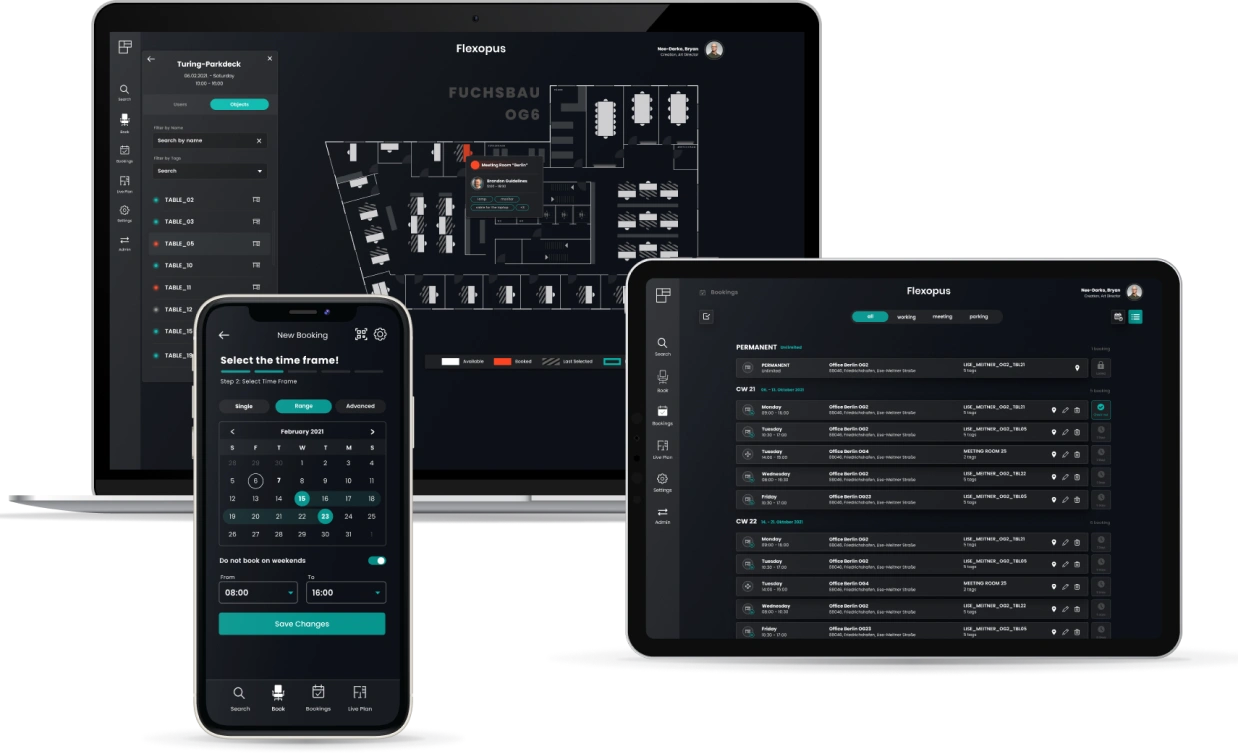
Companies are looking for innovative solutions to optimize the use of office space, and desk sharing has proven to be a game changer. Desk sharing allows employees to use office space as needed, thus preventing the scenario of empty offices. Flexopus, an innovative desk sharing tool, proves to be invaluable in this context. Here is the reason why:
- Dynamic allocation of workstations: Flexopus enables dynamic allocation of workstations based on actual occupancy requirements. With the Live Plan, employees always have an overview of the current occupancy of their office.
- Resource efficiency: By sharing desks, companies can significantly reduce the need for excess office space, resulting in significant cost savings. Flexopus' Smart Analytics feature monitors object utilization to enable informed decisions for space optimization.
- Seamless integration: Flexopus integrates seamlessly into existing office infrastructures, enabling a smooth and efficient transition to desk sharing. E.g. Flexopus can be integrated into MS Teams and MS Outlook .
- User-friendly interface: Flexopus' user-friendly interface optimizes the desk sharing experience for employees and management alike. No complex onboarding is required – you can get started right away.
Convert empty offices into attractive spaces

An innovative consequence of the desk sharing trend is the possible conversion of empty offices into versatile spaces. The lower demand for large, purpose-built office space enables the conversion of commercial properties. Cities are already beginning to seize this opportunity and transform unused office space into dynamic coworking hubs, community centers, or other essential facilities.
- Adaptive Reuse: Vacant office space can be redesigned to meet the changing needs of the community, fostering a more dynamic and responsive urban environment.
- Collaborative Collaboration: Coworking spaces, created from former offices, promote collaboration, networking, and the mutual enrichment of ideas among diverse professionals.
- Sustainable urban development: The conversion of vacant offices into multifunctional spaces is in line with the goals of sustainable urban development, as it promotes resource efficiency and reduces the carbon footprint associated with traditional office space.
Empty spaces can also be used to improve the experience of employees in the company. There are numerous examples of how these office spaces can be transformed. Some of the creative and great solutions include:
- Dedicate the space to sport and well-being
- set up a kitchen or a coffee corner
- Areas for team-building activities (e.g. climbing wall or board games)
- Opening a learning and training center, etc.
- Sofa corner with smart TV and games console for relaxing
conclusion
Optimizing office space through desk sharing is becoming a key strategy in the changing world of work. Flexopus is at the forefront of this movement, providing a powerful tool to streamline desk sharing processes, reduce costs, and increase flexibility in the workplace. The conversion of vacant offices into lively community spaces demonstrates the potential for dynamic and sustainable urban development. The future of work is dynamic, and with innovative solutions we can turn challenges into opportunities and ensure that office spaces remain vibrant and fit for purpose for years to come.
The most important questions summarized
Why do rigid office concepts often lead to inefficient vacancy rates in today's working world?

Classic concepts are based on the principle of “one desk per person.” However, as a result of working from home, business trips and holidays, up to 50% of the seats remain unused on many days. This rigid allocation prevents areas from being flexibly adapted to actual requirements. In a hybrid world, the fixed workplace thus becomes a cost trap, as companies pay expensive square meters for absences instead of freeing up space for dynamic collaboration or alternative uses such as focus zones or lounges.
How does desk sharing software support the data-based optimization of office space?
Software solutions such as Flexopus make unused capacities visible. Digital booking data provides companies with precise analyses of the actual utilization of individual zones or days of the week. Instead of relying on gut feeling, management decisions can be based on hard facts: Which areas are overloaded? Where are tables permanently empty? This transparency makes it possible to reduce rental space, check sublets or specifically convert rooms into more attractive formats such as team hubs, which massively increases space efficiency.
What are the economic benefits of reducing empty office space?
The biggest lever lies in reducing fixed costs. Less space required means lower expenses for rent, ancillary costs, cleaning and maintenance. In addition, energy consumption for heating and lighting is significantly reduced, which also improves the sustainability balance (ESG goals). The saved capital can instead be invested in higher-quality equipment for the remaining space in order to position the office as a magnet for talent. Economic efficiency and modern workplace attractiveness therefore go hand in hand.
Last updated:
2026-05-29
.svg)

.webp)
.webp)