Digital signage in a hybrid office: Why it makes sense
Digital displays are now an integral part of modern offices. Digital signage makes use of space visible, simplifies booking processes and ensures clear orientation and greater efficiency in everyday working environments, especially in hybrid work environments. Find out more about it in this article.
Table of contents
Digital signage refers to the use of digital displays to display information, content or status messages in real time. In a work context, digital signage is found primarily in offices, corporate headquarters and public buildings, e.g. in the form of electronic door signs, information displays or meeting room displays for room booking.
In the new work environment, digital signage has long been more than just a way to display information. Used correctly, it becomes a central component for efficient use of space and better orientation in everyday office life.
What is digital signage?
Digital signage is a collective term for digital display systems that display content dynamically, centrally controlled and location-based. In contrast to printed notices or static signs, information can be updated, automated and displayed in a context dependent on the context at any time.
Typical forms of digital signage in offices include:
- Digital door signs in meeting rooms
- Electronic door signs at individual offices or zones
- Displays for meeting room booking and room booking
- Information screens in reception areas or common areas
The key questions asked by employees are answered quickly: Who uses which room and when? Is a meeting room vacant or occupied? Which booking is next? Where is my favorite colleague sitting today? Where can I find the first aider in an emergency?
In addition, a booking can be made directly on the display if a room is needed ad hoc. Via Smart TV, you can also display an attendance indicator or a meeting room finder to make the office even more efficient.
What does digital signage do?
.webp)
The core task of digital signage is to provide information in a visible, up-to-date and understandable way. In everyday work, digital signage primarily performs four central functions:
1. View information in real time
Digital displays can immediately display occupancy status, times, booking details or information. Changes are immediately visible — without the need to manually replace signs or notices.
2. Facilitate orientation in the office
Digital signage provides clarity, especially in flexible office concepts with desk sharing and variable meeting rooms: Employees can see at a glance where meetings are taking place or which rooms are available. In larger offices, employees can use the Meeting room finder to see at a glance which room or telephone booth they can access.
3. Simplify processes
The combination of software and display makes room booking much more intuitive. Rooms can not only be booked digitally, but can also be viewed on site on the display or, depending on the system, reserved directly. Ideal especially for spontaneous appointments, calls or workshops.
4. Create transparency
Digital signage makes usage visible. Anyone looking for a room can immediately see whether it is vacant or will be needed soon. This reduces inquiries, double bookings and uncertainties. In addition, a visible attendance display can be used to see where colleagues are sitting and thus the first aider can be found immediately in an emergency.
Digital signage in everyday work
In the modern office, digital signage is not an isolated tool, but part of an efficient Workplace Management. Its use is particularly relevant in the following areas:
Digital and electronic door signs
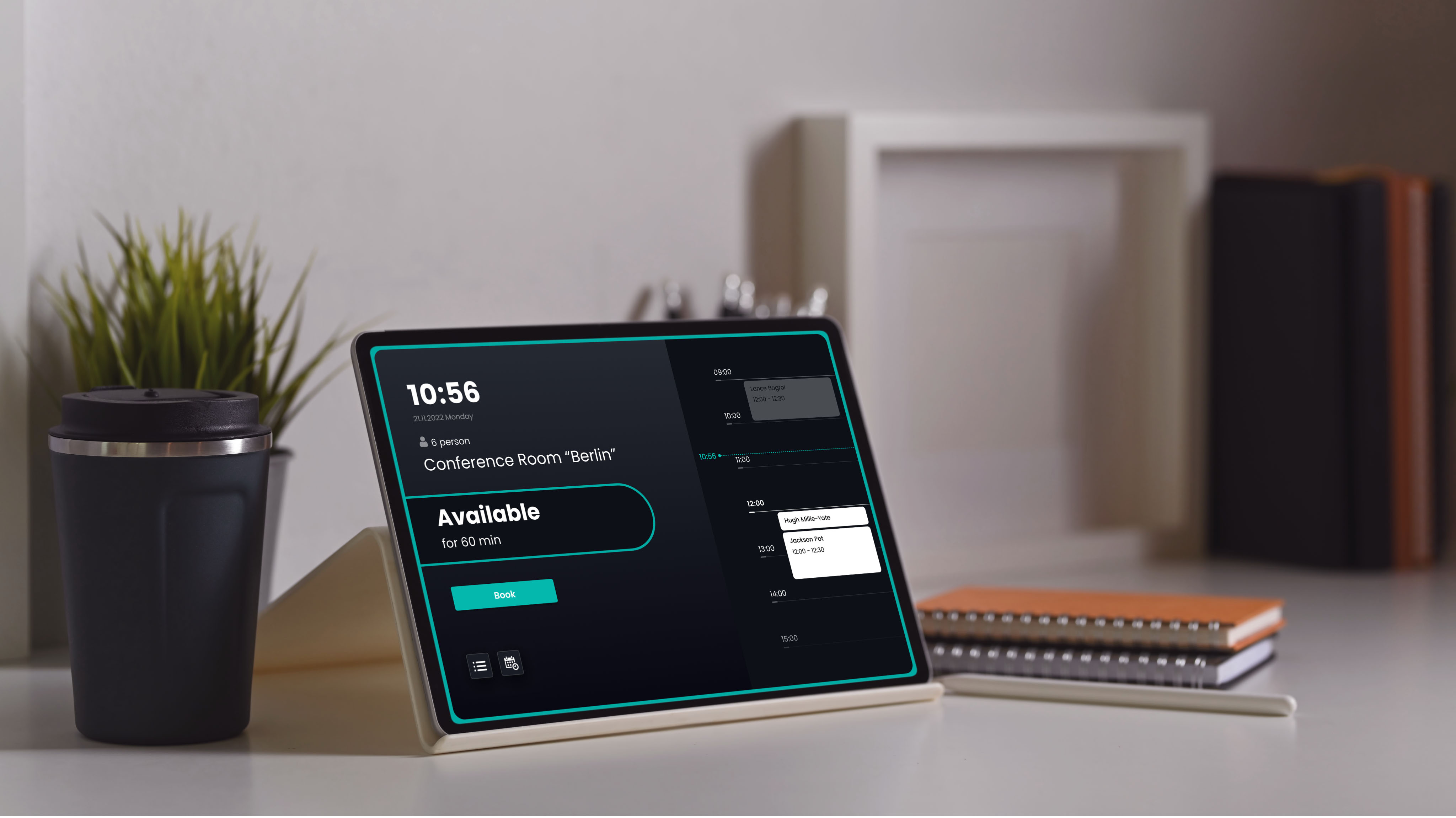
Digital door signs replace classic name signs or room signs. They show:
- Room name and room number
- Current occupancy status: Is the room vacant or occupied?
- Name of the meeting or person making the booking
- Start and end time of booking
- Upcoming room bookings
Electronic door signs with Flexopus update themselves automatically and reflect the actual usage status. This is particularly helpful in dynamic office environments where rooms are no longer permanently assigned.
Make meeting room booking visible
A central use case of digital signage is meeting room booking. Meeting room displays on rooms clearly show whether a room is vacant or occupied and when a new booking can be made.
This eliminates the classic “door handle testing” (and, in the worst case, barging into an appointment) or the frustrating search for free spaces. Meetings start more punctually, spontaneous coordination becomes easier and the daily routine becomes smoother.
In many office concepts, rooms are planned digitally but used physically. Digital signage connects these two worlds. Employees can see how a room is being used directly on site and can adjust their planning accordingly.
Why do you need digital signage in the office?
The need for digital signage is primarily caused by changes in working methods. Hybrid work, flexible attendance and shared resources place new demands on the organization of space.
1. Flexible working models
When all employees are no longer in the office at the same time, occupancy patterns change. Digital signage helps to make this dynamic visible and to use resources wisely.
2. Shared rooms instead of fixed allocation
Meeting rooms, project rooms, or focus zones are no longer assigned to individual teams. Digital displays show how these rooms are currently being used, without additional manual coordination.
3. Less coordination, more clarity
The more transparent information is, the fewer queries arise. Digital signage reduces internal communication to the essentials because many questions are already answered visually.
What are the benefits of digital signage?
The practical added value of digital signage is particularly evident in everyday life. One of the things that makes it easier is to save time looking for rooms that are still available. With the meeting room finder, you can see at a glance which room is occupied and which is not. Such a meeting room finder can be displayed on a smart TV and placed centrally in the office.
Another relief is definitely that there are fewer disruptions when colleagues desperately search for a room and accidentally burst into a meeting. This is ruled out with digital signage and therefore full concentration can be given to the meeting.
Digital signage also ensures better and higher room utilization. By displaying bookings transparently, rooms are used more consciously. Idling and incorrect assignments can be reduced. Using the displays is intuitive and self-explanatory. Colors, symbols and clear information make the status of a room immediately understandable, even for new employees or guests.
In addition, the digital presence indicator makes it easier to search for team members. The data protection officer or IT expert can be found more quickly and can be addressed in a targeted manner.
Digital signage and room booking in combination
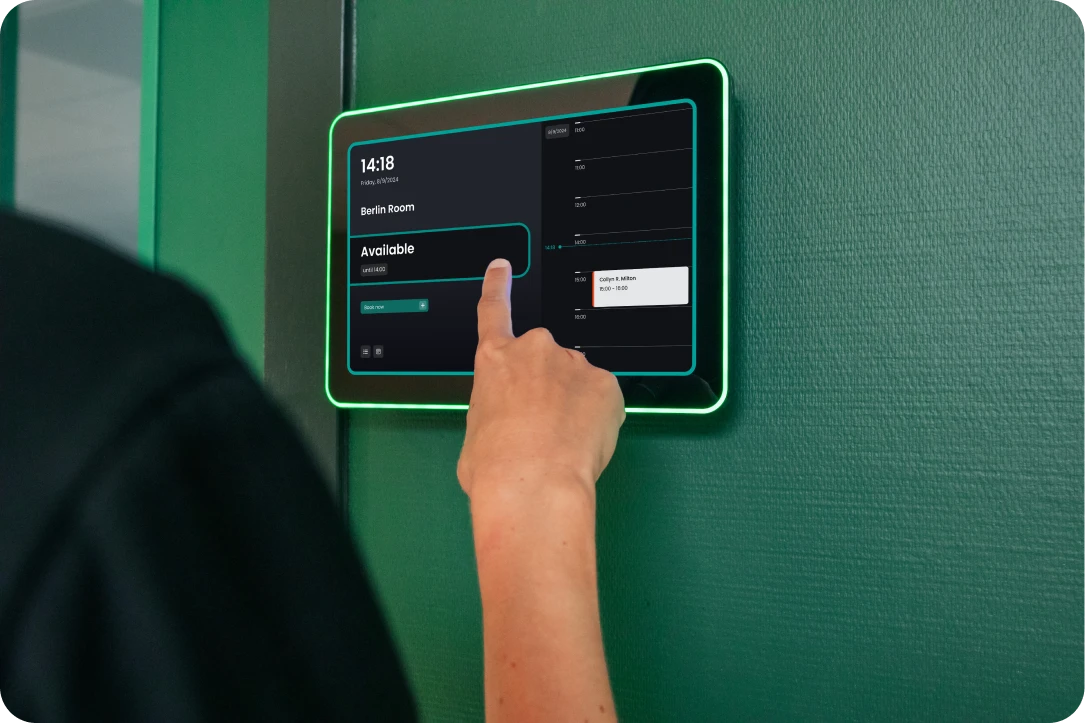
The full benefits of digital signage come when combined with a digital room booking system like Flexopus. While the software manages bookings in the background, the display takes care of visual communication on site.
This interplay ensures that:
- Bookings are displayed correctly
- Changes are immediately visible
- The physical space matches the digital calendar
Especially when booking a meeting room, this connection is very relieving for employees, as it allows you to find and book a room spontaneously. For example, if an important customer, supplier, partner or colleague calls and you need to talk confidentially, a room or telephone booth should be available quickly — without having to open your laptop or pull out your smartphone to find and book a room.
Distinction: digital signage vs. classic signage
Compared to analog signs, digital signage offers clear advantages:
- Timeliness: Content changes automatically, synchronized with the calendar from Microsoft, Google, etc.
- Flexibility: spaces can be redefined without changing signs
- Scalability: More rooms don't mean more administrative work
- Integration: Meeting room displays can be integrated into existing systems
This makes digital signage an integral part of modern office organization.
Conclusion: Digital signage as a component of modern working environments
Digital signage is in New work context much more than just a technical extra. It creates transparency, simplifies processes, minimizes frustration and supports flexible working models. Especially when combined with digital meeting room booking, digital signage is becoming an indispensable tool in everyday office life.
Companies that rely on flexible use of space, hybrid work and clear communication benefit directly from digital signage: through less frustration, better orientation and a noticeably more efficient working day.
Flexopus offers digital signage in full and thus offers an all-in-one solution as a modern Workplace Management Software.
The most important questions summarized
What is digital signage and what role does it play in modern office life?

Digital signage refers to the use of digital media content in advertising and information systems, such as screens or projections. In everyday office life, it serves as a dynamic means of communication: It replaces static notices with real-time information. Whether it's news tickers, greeting guests or orientation aids — digital signage ensures that information ends up exactly where it is needed. It increases the efficiency of internal communication and makes a significant contribution to a modern, technologically advanced working atmosphere.
How does digital signage actually improve room and booking management in companies?
In the area of room management, digital signage is a game changer. Digital door signs directly on the meeting room show whether it is occupied or vacant. In combination with booking tools such as Flexopus, rooms can often be reserved ad hoc via touchscreen. This prevents double bookings and interruptions to ongoing meetings. In addition, overview maps (floor plans) can show on large screens in the entrance area which workstations are currently available. This saves time when searching, optimizes space usage and creates a seamless employee experience.
What are the technical requirements for implementing digital signage?
An effective system requires three components: hardware (displays, players), software (content management system) and a stable network connection. Modern solutions often rely on cloud-based software, which makes it possible to centrally control content and distribute it to various locations worldwide. Digital signage is particularly efficient when it has interfaces (APIs) to existing systems such as calendars or desk sharing software. In this way, information is automatically updated, which minimizes manual maintenance costs and ensures data quality.
Last updated:
2026-03-16