Desk Sharing
2026-02-27
.webp)
Desk sharing & personal items: How to keep the workspace truly usable in a sharing model
Desk sharing often fails not because of software, but because of personal items: bags, accessories and paper create disorder, search times and conflicts. The article shows best practices such as clean desk rules, standardized equipment and clear communication. Bookable lockers make storage space fair, secure and suitable for everyday use.

Table of Contents
Desk sharing has long been more than just a trend in many companies. The concept promises greater flexibility, better use of office space and often lower costs per workplace. In practice, however, it quickly becomes apparent that personal items are one of the most common points of friction when introducing desk sharing. As soon as there is no longer a fixed desk, storage space and routine are missing. Bags get in the way, equipment moves from desk to desk, and rules are interpreted differently. This influences the work environment, productivity and, last but not least, acceptance among employees and colleagues.
Anyone who wants to make desk sharing successful therefore needs not only software and booking logic but also a clear principle for personal items: What belongs at the workplace, what belongs in central areas, and what is the option for secure storage space? This article describes exactly that — including best practices, clean desk rules, and a solution with bookable lockers.
Why desk sharing makes personal items a challenge
No longer a permanent job — what is changing?
In the classic work model, the workplace is often personal: desk, drawer, monitor setup, documents. Desk sharing eliminates this fixed basis. Instead, the desk is used daily or situationally — often in combination with home office. This not only changes usage, but also needs and expectations of the organization:
- The desk is no longer a personal storage space, but a shared resource.
- Work areas are becoming more dynamic: employees change places, teams sit together as needed, rooms are used more flexibly.
- Employers need to think more about equipment, organization, communication and processes because “following” old habits no longer works.
- Employees must adapt their working methods: What is needed on a daily basis, what can stay in the office, what must be brought into the home office?
In Hot Desking or shared desk models, these changes are normal - but without clear rules, this quickly leads to disadvantages: search times, disorder, conflicts over space and a work environment that seems improvised rather than professional.
Typical problems with personal items
Personal items often become a problem with desk sharing for the same reasons — regardless of whether it's a small office or large office space in multiple locations:
- Bags and jackets block space at work or in the corridor because there is no defined storage space.
- Objects such as a mouse, headset, adapter, or charging cable “wander” between work areas and are missing the next day.
- Private documents, notes or printouts remain at the desk and become a security and data protection issue.
- Different equipment leads to frustration: one desk has docking, the next doesn't; one seat has the right ergonomics, the next doesn't.
- Colleagues regard private “permanent traces” in the workplace as unfair because the sharing principle dilutes.
- The works council aspect becomes relevant when rules, control, cleaning or personal issues are unclear.
In short: Desk sharing is not just a booking model, but an organizational model. And personal items are the most visible adjustment screw.
The solution: Make lockers bookable with Flexopus!
.png)
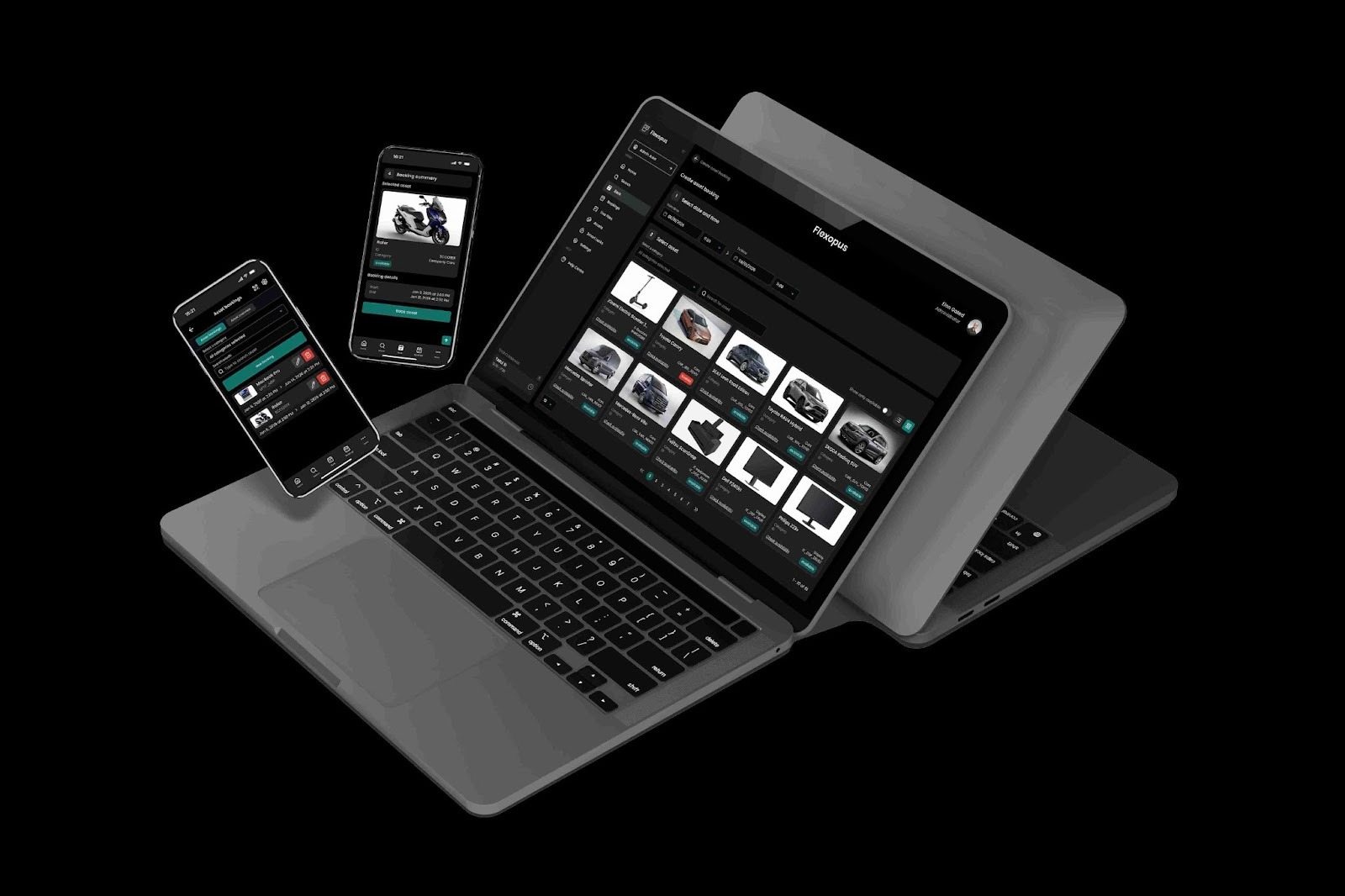
Lockers (lockers) as a bookable resource are a robust solution for desk sharing & personal items. The locker replaces the missing drawer at the desk — without losing the advantage of flexibility. Integration into the desk sharing system is crucial: When lockers are booked and managed in the same way as workstations, meeting rooms or other resources, a consistent model is created for the entire organization.
With the Flexopus Asset Management, lockers in the office can be mapped as a resource and made bookable. This turns “drop it somewhere” into a clear option: Employees book a workplace and, if necessary, an additional locker. This supports the introduction because the principle is easy to explain: keep the desk clear, store objects safely, share a workplace.
It is also worth taking a look at a locker integration: Through an integration with smart lock systems, it can be even easier to use because lockers can be controlled digitally.
Why bookable lockers are so useful in the shared desk model:
- Security for objects, devices, and documents
- Fewer “transport pendulums” between home office and office
- Clear rules can be implemented in practice (instead of just existing on paper)
- Organization in the office, cleaner work areas, fewer conflicts over space
- Scalability for multiple locations, floors, and office spaces
- Fairness in sharing: Use is transparent and regulated
Best practices for handling personal items in the shared desk model
To ensure that the concept of desk sharing does not fail due to details, personal items should be planned as part of the working model. The following tips are deliberately practical: They help you get started, but they also work in the long term as usage increases.
Personal belongings at work
It is important to only take what is really necessary with you. In addition, objects can also be stored in lockers between working days. This increases accessibility in the office and also makes commuting to work easier, as you don't always have to carry everything with you.
Rules and Clean Desk Policy: Order is a process, not a request
A Clean Desk Policy is not “nice to have” in desk sharing, but the foundation of it. It determines what is left behind after working at work - ideally, nothing that disturbs others or creates risks. Rules must be not only formulated, but also enshrined as a principle in everyday life:
- Clear the desk after use
- Store items in lockers or defined areas
- Don't leave documents and sensitive documents uncovered
- Clearly communicate the standard for cleaning and equipment
Standardize equipment: fewer private items, more productivity
Many personal items are brought along only because equipment at the workplace is not uniform. Standardization reduces the need for private equipment and increases productivity:
- Standard monitors, docking, power supply
- Uniform periphery (where appropriate) or clear hygiene rules
- Clear identification of workplaces and work areas
- Defined resources for special needs (e.g. quiet areas, telephone boxes, focus areas)
The more consistent the equipment, the less “packing list” is required — and the better the desk sharing principle fits reality.
Introduction, communication, and guidance: Desk sharing is not introduced “on the side”
Desk sharing is a change in work, not just new software. A successful introduction requires communication, clear rules and understandable logic for all colleagues. The following has proven effective:
- Pilot phase in selected areas of work
- simple rules (few but consistent)
- transparent communication: advantages, principle, use, need for resources
- suitable materials and guidelines for the company
At Flexopus, we have already successfully helped many companies introduce desk sharing and locker integrations. For that, we developed a dedicated desk sharing guide, which we make freely available.
Conclusion: Desk sharing works when personal items are rethought
Desk sharing and personal items are not a side issue, but a core factor for acceptance, order and productivity. If bags, objects and equipment remain unexplained, disadvantages quickly arise: restless working environment, conflicts over space, inefficient use of office space and a desk sharing model that creates more effort than benefit in everyday life.
With clear rules, a consistent clean desk policy, standardized equipment and bookable lockers as a solution, the sharing principle is suitable for everyday use. The combination of desk sharing software and locker integration is particularly effective because it combines personal needs (storage space, security, convenience) with the flexibility of the working model — in the office, across locations and suitable for the organization.
The most important questions summarized
Why do personal items become such a problem with desk sharing?

Because the desk is no longer a personal "base." Without a fixed storage space, bags, jackets, or printouts end up on the desk or in the aisle, and accessories go missing. Leftover documents also become a security and data privacy issue. Without clear rules, an improvised rather than professional work environment quickly emerges.
How do bookable lockers help make desk sharing actually work?
Lockers replace the missing drawer: employees store devices, documents, and personal items securely without "marking" a desk. This reduces transport between home and office, creates order, and makes clean-desk policies practical. When lockers are bookable in the system just like workstations, it creates a consistent, fair model—even for multiple locations.
Which best practices most effectively increase order and acceptance in a shared-desk model?
A consistent clean-desk policy (clearing the desk, not leaving sensitive items behind, defined storage/lockers), standardized equipment (monitor, docking, power, ergonomics), and clear labeling of areas. It is also important to have a smooth rollout: start a pilot, consistently follow a few rules, explain the benefits transparently, and support employees with guidelines and communication.
Last updated:
2026-10-12
.svg)

.webp)

