Hybrid working
2026-11-10

Working from home or the office? The perfect balance – what science says
More office time or more flexibility? As the Mercedes case demonstrates, few questions are currently sparking as much debate in companies. In this article, you will learn what studies say about the ideal balance between working from home and the office, why mandatory attendance often backfires, and how you can use team days, wild cards, and collaborative workshops to create rules that your team will actually support.

Table of contents
Hardly any topic divides the working world as much as the question of where work should take place. On one side are companies demanding more in-office presence; on the other are employees defending their flexibility. Both sides have valid arguments, yet they often talk past each other. Many employees feel misunderstood, while many managers feel held back. It is high time to bring objectivity to the debate: What does research say about the ideal balance between working from home and the office? And how can companies create rules that connect rather than divide?
Mercedes means business and the debate is heating up
Mercedes-Benz is currently demonstrating just how charged this topic is. The company has terminated its existingworks agreement on mobile working; full-time employees are expected to workfour days per weekin the office in the future. The leverage behind this is explosive: if no new agreement is reached, all employees would have to return to the office from Monday to Friday – the board's offer is four days. According to reports, CEO Ola Källenius had originally even considered a return to five-day attendance. The mood among the workforce is already tense: at the beginning of July 2026, around 33,000 employees at ten German locations took to the streets to protest against company policy.
Mercedes justifies the move by stating that the workplace should once again be the central hub for collaboration, knowledge transfer, and innovation. A understandable goal. The only question is: do you achieve it through mandates or through conviction?
What the science says
Arguably the most robust study on the subject comes from Stanford economist Nicholas Bloom. Together with Ruobing Han and James Liang, he published the first controlled experiment on the effects of hybrid work in the journal Nature. Over six months, 1,612 employees at the travel company Trip.com were studied—with a focus on retention, satisfaction, productivity, and career development.
The result is clear: two days of working from home per week did not impair performance orpromotion prospects, while the resignation rate fell by about a third. Women, employees without management responsibilities, and people with long commutes benefited in particular. The perspective of the managers is also interesting: before the experiment, they expected a productivity loss of 2.6 percent; in the end, they actually estimated a slight increase of one percent. The consequence: Trip.com subsequently introduced hybrid working throughout the entire company.
However, it is important to put this into perspective: the study shows that two home office days can work in a large company, but it does not prove that exactly three office days are ideal for every job.
Data from Germany also paints a clear picture. According to the Konstanz Home Office Study employees want an average of 2.78 home office days per week by 2026—a figure that has remained remarkably stable for years. At the same time, skepticism toward rigid requirements is growing: only 22 percent of managers now support stricter mandatory office attendance, down from 25 percent in 2025 and 33 percent in 2024. Study director Florian Kunze sums it up: his data suggests that mandatory office attendance often does more harm than good. The study also shows a correlation between stricter attendance requirements and emotional exhaustion.
The research conclusion:The sweet spot for most knowledge workers is about two to three days in the office per week. However, the exact number is less important than the question of what happens on those days.
Privilege or right? The perception gap
Behind many conflicts lies a fundamental misunderstanding. Companies like to speak of the "home office privilege"—a benefit that is granted and can be withdrawn if necessary. Many employees see it differently: for them, it is working from home long since a natural part of their employment contract, their life planning, and their work-life balancehas become the norm. For those who have structured their childcare pickups, commutes, or caregiving responsibilities around hybrid work, a reversal is not seen as the end of a privilege, but as a loss.
Incidentally, the legal situation is clear: in Germany, there is no legal right to work from home, so employers can often bring their employees back to the office. But what is legally possible is not automatically wise. Those who bring employees back to the office against their will risk dissatisfaction and resignations, and thus the loss of skilled workers.
The real problem is rarely the policy itself, but how it is implemented. Whenin-office attendanceis mandated from the top down without explaining the "why," it quickly creates an impression of distrust and control. Employees feel unseen—and that is exactly where the opportunity lies.
Why it still makes sense to come to the office

As clear as the studies are for hybrid work the office is not obsolete. On the contrary—when used correctly, it is irreplaceable. Because some things simply work better on-site:
- Spontaneous interaction:A quick question at the coffee machine often solves problems that would otherwise require a scheduled remote meeting.
- Learning and onboarding:Early-career professionals, in particular, benefit immensely from being able to look over the shoulders of experienced colleagues.
- Creativity and innovation:Brainstorming sessions, workshops, and strategic discussions develop a different dynamic when everyone is in the same room.
- Relationships and trust:Teams that know each other personally collaborate more smoothly, even when working remotely.
- Sense of belonging:Corporate culture is built through shared moments—and those rarely happen on a video call.
The crucial point: the office must offer added value that the home office cannot. Anyone commuting to the office just to sit in video conferences all day will not see the point. Management consultant Burghardt puts it aptly: Mandatory attendance without changing how you work, it’s just a change of location. Their advice to managers: before every in-office day, clarify which decision needs to be made, which problem needs to be solved together, and what knowledge should be shared.
Creating the right framework: How to strike the balance
Instead of rigid quotas, companies need a clear framework that combines commitment with flexibility. These five building blocks have proven effective:
1. Clear, understandable rules
Whether it’s two or three fixed office days, the policy should be communicated transparently and with clear reasoning. It makes sense to have designated team days when everyone is on-site if possible. After all, nothing is more frustrating than commuting to the office only to find no one from your team there.
2. The Wild Card: one exception per quarter
Life doesn't follow office attendance rules. A repair appointment, a sick child, a project that requires full concentration—sometimes an office day just doesn't fit. A "wild card" per quarter gives employees the option to move a mandatory office day to home office without needing to provide a reason. This costs the company nothing, but it signals trust and takes pressure out of the system. A rigid obligation becomes a sensible agreement.
3. Create formats that make the commute worth it
In-office days need substance. Fixed formats give the office a purpose: a weekly team breakfast, on-site sprint planning, lunch & learn sessions, after-work drinks, cross-departmental discussion rounds, or a monthly innovation day. When employees know they would miss out on something on a specific day, they come in voluntarily.
4. Set goals instead of measuring attendance
Good work is measured by results, not by the number of hours spent at a desk. Clear goals—such as those based on the OKR principle —provide direction, no matter where work is being done. At the same time, goals for collaboration can also be defined: How often do we want to see each other in person as a team? Which tasks do we consciously choose to complete together on-site? This turns office attendance from an end in itself into a tool.
5. The workshop: developing rules together
The most effective way out of the "privilege vs. right" dilemma is participation. In a workshop, teams work together to determine which activities make more sense on-site and which work better remotely. Possible guiding questions:
- Which tasks benefit most from personal interaction?
- On which days do most team members prefer to be in the office anyway?
- What is missing in the office that would make us enjoy working there?
- What exceptions do we need and how do we handle them fairly?
The result is a team agreement that everyone supports. Rules that you have helped shape are not perceived as coercion. And managers learn what really matters to their employees.
Organizing hybrid work with Flexopus
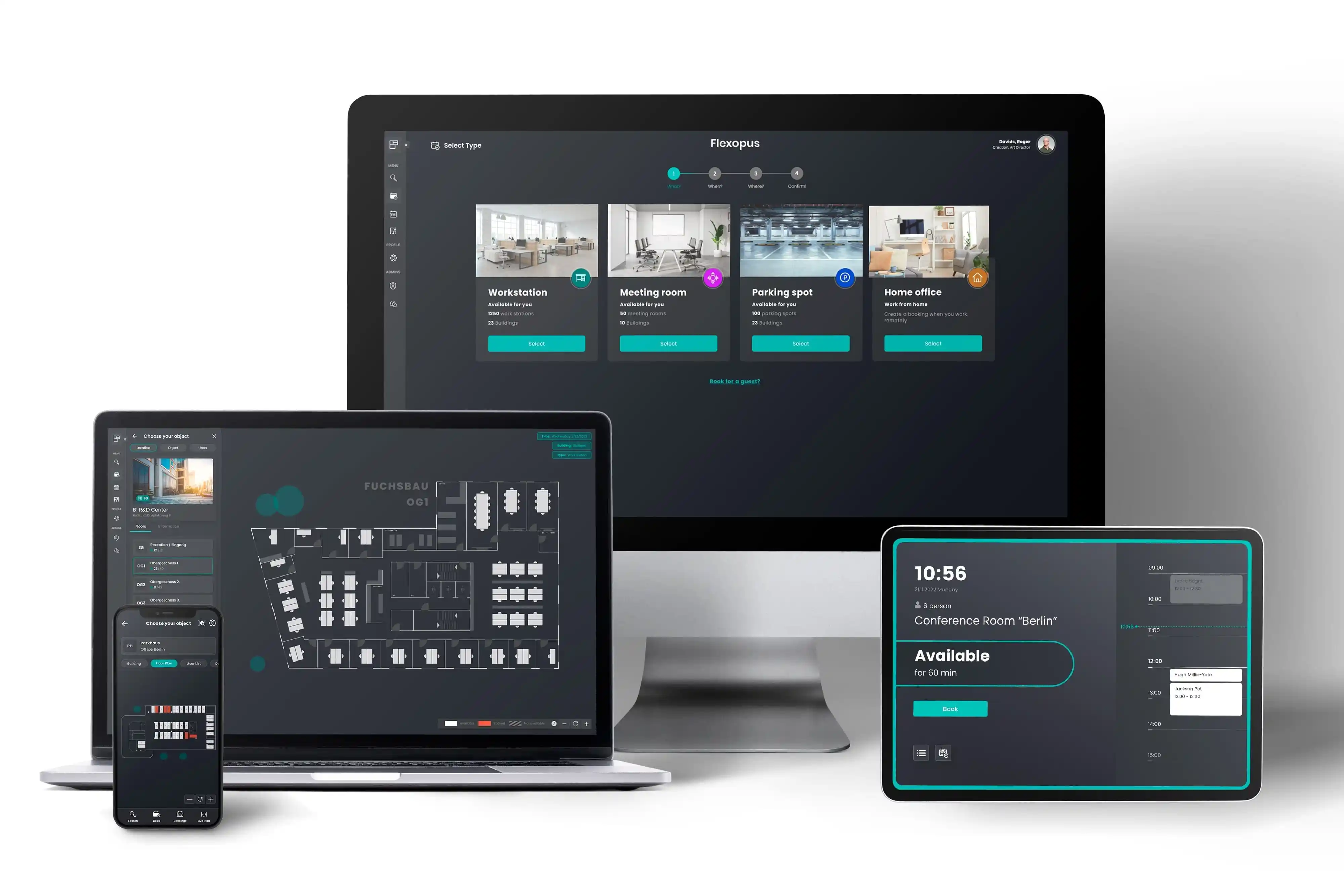
For in-office days to work in everyday life, you need the right organization. workplace management software Flexopus bundles all the components of the hybrid office into one platform: with the Desk booking employees can reserve their desk via an interactive floor plan and see who is in the office and when on the live occupancy plan. This allows team days to be planned effectively. The Room booking is directly linked to Outlook, Exchange, and Google Calendar, complemented by Parking booking,Visitor management software,Asset & Inventory Management Softwareas well as Catering & Office Services for team breakfasts or workshops.
On-site, Room displays, occupancy indicators, e-paper desk displays, sensors, and check-in QR codes ensure that unused bookings are automatically released. Smart analytics provides the data foundation for fair office attendance policies. Over 80 integrations, including the Microsoft Teams app, Entra ID, Google Workspace, and HR systems like Personio, seamlessly embed Flexopus into existing workflows. Hosted in Germany, GDPR-compliant, and billed per resource rather than per user.
Conclusion: It’s not the quota that matters, but the purpose
Science provides a clear direction: hybrid models with about two to three office days per week best combine productivity, job satisfaction, and employee retention. Conversely, strict mandatory office attendance carries the risk of burnout, frustration, and turnover—without any demonstrable gain in productivity. The Mercedes case shows how quickly an attendance debate can escalate into a cultural conflict.
The key is to make the office a place where people want to be: with clear guidelines, meaningful formats, shared goals, some flexibility in the form of a wild card, and rules that are developed through dialogue rather than by decree.
The most important questions summarized
According to research, how many office days per week are ideal?

For most knowledge workers, the sweet spot is two to three days in the office per week. This is shown, among other things, by a randomized experiment conducted by Stanford economist Nicholas Bloom with 1,612 employees at Trip.com: two remote work days did not impair performance or promotion prospects, and the turnover rate actually dropped by about a third. However, what actually happens during those office days is even more important than the exact number.
Does a strict mandatory attendance policy actually benefit companies?
Usually, no. According to the Konstanz Home Office Study, employees expect to work from home an average of 2.78 days per week by 2026, and only 22 percent of managers support stricter mandatory attendance. The data also shows a correlation between rigid requirements and emotional exhaustion. Those who mandate office attendance without justification risk frustration and resignations without any measurable productivity gains.
How can companies create attendance policies that employees are happy to support?
By using a clear framework instead of rigid quotas: scheduled team days where the entire team is on-site, formats like team breakfasts or workshops that make the commute worthwhile, and a "wild card" per quarter for spontaneous exceptions. Participation is the most effective approach: when teams develop their own rules, they are not perceived as coercion. Tools like Flexopus help make planning team days, desks, and meeting rooms simple.
Last updated:
2026-11-12