
Desk Sharing Ratio: The Key to Hybrid Work
The desk sharing ratio is a key metric for determining whether office space is being used efficiently and if desk sharing is working within the company. It also provides a basis for decisions regarding space planning and the optimization of hybrid work models.
Table of Contents
What is a desk sharing ratio?
Terms like desk sharing, New Work, and hybrid work have become an integral part of everyday office life. The working world has changed permanently since the COVID-19 pandemic, and many companies now rely on flexible workplace models that allow employees to regularly switch between working from home and the office. A central metric in this context is the desk sharing ratio. It is the key to successful hybrid work.
The desk sharing ratio describes the relationship between the number of available workstations (desks) in the office and the number of employees. The goal is to create a more compact and efficient work environment where fewer desks are needed than there are employees. The idea behind it: many employees work from home or remotely on a regular basis anyway. So why permanently assign a fixed desk to everyone?
When the desk sharing ratio is applied effectively, it offers benefits such as:
- Cost savings: Significant reduction in rent, operating, and energy costs.
- Better space utilization: More efficient use of existing office space.
- Less vacancy: Avoiding unused desks and rooms.
- Increased flexibility: Promoting modern work models and employee satisfaction.
Why is the desk sharing ratio so important?

An optimal desk sharing ratio can save a lot of money, especially in terms of rent, operating costs, and energy. But it is more than just a cost factor: it is a strategic management tool for effective workplace management, designed to meet modern hybrid work needs while improving office utilization.
A study by the Fraunhofer Institute for Industrial Engineering (IAO) shows that over 60% of employees surveyed split their working time fairly evenly between home and the office. Around 80% also report that their productivity has increased due to the flexibility gained.
This development confirms that desk sharing is not just a trend, but a long-term, viable concept, both economically and culturally.
Desk sharing therefore makes sense not only for employees, but also for companies that want to position themselves as modern employers while simultaneously realizing savings.
How is the desk sharing ratio calculated?
The desk sharing ratio shows how many workstations are available in relation to the relevant number of employees. It helps companies plan office space realistically and avoid overcapacity.
The formula is:
Desk sharing ratio = Number of available desks / Number of relevant employees × 100
An example:
A company has 100 employees who could theoretically use an office workstation, but only provides 70 flexibly bookable desks.
70 desks / 100 employees × 100 = 70% desk sharing ratio
This means: There are 70 desks available for 100 employees.
How to interpret the result:
Ratio = 100%:
Mathematically, there is one dedicated desk for every employee. This corresponds to the classic office model with fixed workstations.
Ratio < 100%:
There are fewer desks than employees. This is common with desk sharing, hybrid work, and working from home.
Ratio > 100%:
There are more desks than employees. This may indicate overcapacity, vacancies, or unnecessary space costs.
A desk sharing ratio below 100% is generally sensible for hybrid work models. However, it is crucial that the ratio matches actual office usage. If it is set too low, it can lead to shortages, frustration, or unclear booking situations on high-traffic days.
It is also important to note: The calculation should not be based on all employees across the board, but rather on the relevant user group. Field staff, part-time employees, permanently remote workers, or employees without a regular need for an office workstation should be considered separately depending on the usage concept.
What are the prerequisites for a functional desk sharing ratio?
For desk sharing to work smoothly, you need more than just a good ratio. The following three prerequisites are decisive:
1. Is your office space being used effectively?
The first step is an honest assessment of the space being used. With hybrid work, it often becomes clear that the entire office space is no longer needed. Large office areas with too few occupied desks look empty and uninspiring.
Ask yourself questions such as:
- Are there regular vacancies?
- Can the rented space be reduced?
- Is the existing space actually being used?
Proper space planning is a key factor in achieving good office utilization and saving costs.
2. What is the composition of your team?
Not all employees have the same work rhythm. Some teams are on-site daily, while others work predominantly remotely. A functional desk sharing ratio depends heavily on how many employees need to be present in the office regularly, such as reception, IT support, or specific project teams.
Consider:
- Who needs daily presence?
- Which roles are location-independent?
- Are there special needs (e.g., parents, part-time staff, external employees)?
Only when it is clear how many workstations are realistically needed can the ratio be adjusted in a meaningful way.
3. Wie hoch ist die tatsächliche Büroanwesenheit?
Ein oft unterschätzter Faktor: Die tatsächliche Anwesenheit im Office. Viele Unternehmen planen nach Bauchgefühl, es gibt aber klare Erfahrungswerte. Seit der Etablierung hybrider Arbeitsmodelle zeigt sich:
Durchschnittlich sind Mitarbeitende an nur 2,5 Tagen pro Woche im Büro. (Durchschnittswerte: 1,5 Tage im Homeoffice, 0,6 Tage Urlaub, 0,3 Tage krank, 0,1 Tage auf Geschäftsreise)
Diese Zahlen sollten bei der Berechnung der Quote unbedingt berücksichtigt werden, denn unrealistische Annahmen führen zu falscher Flächenplanung und Frustration im Team.
Wie unterstützt Flexopus bei der Desk Sharing Quote?
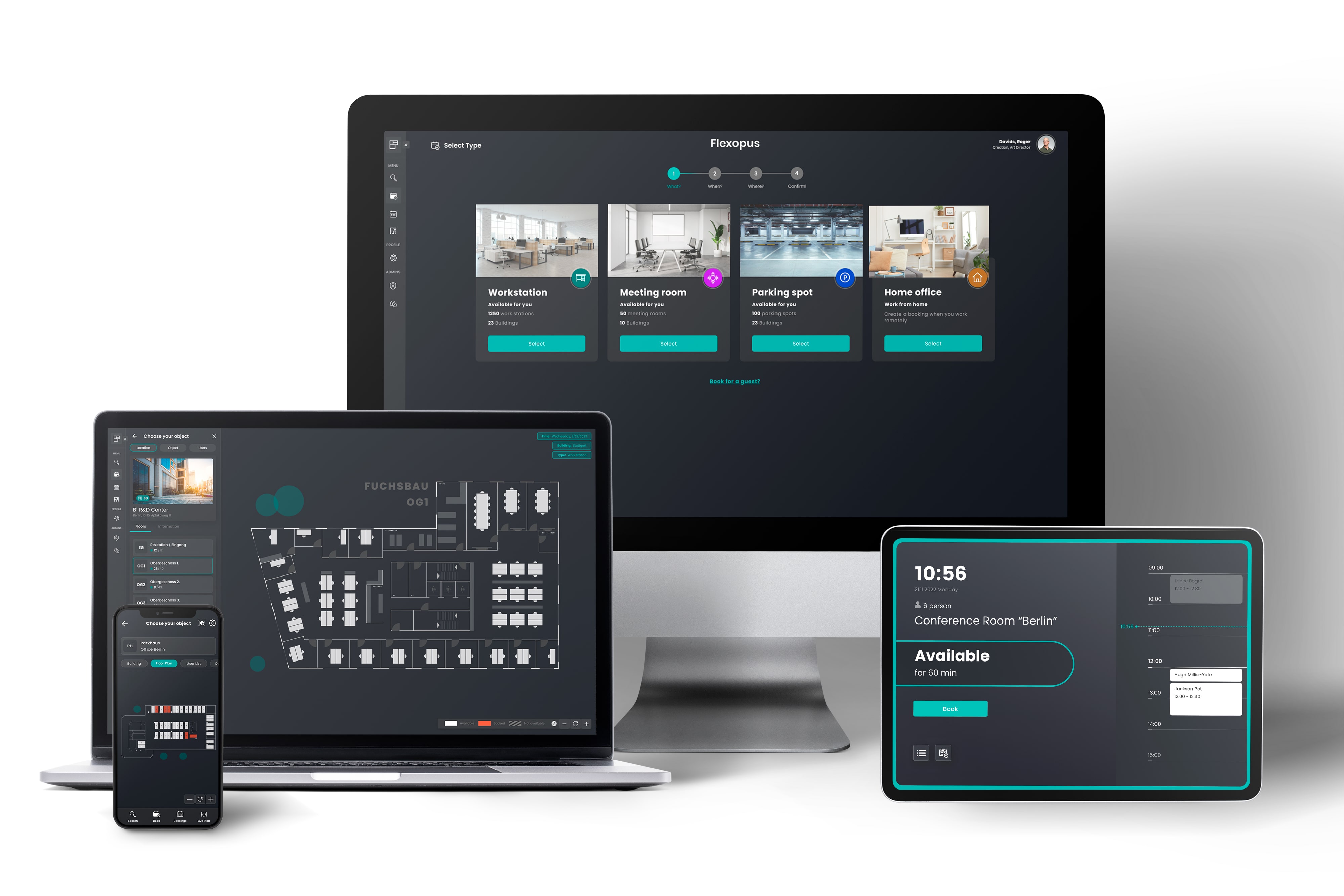
Die beste Quote nützt wenig, wenn Mitarbeitende nicht wissen, wann und wo sie arbeiten können. Hier kommt Flexopus ins Spiel, eine der intuitivsten Softwares für effizientes Arbeitsplatzmanagement und Desk Sharing auf dem Markt.
Flexopus bietet unter anderem ein Arbeitsplatzbuchungssystem, ein Raumbuchungssystem für Besprechungsräume und ein Parkplatz Management System mit Übersicht über verfügbare Plätze in Echtzeit.
Außerdem unterstützt Flexopus bei der Einführung und Optimierung von Desk Sharing:
- Beratung zur Berechnung Ihrer idealen Desk Sharing Quote
- Workshops zur Umstellung auf hybride Modelle
Flexopus lässt sich nahtlos in Ihr bereits bestehendes Ökosystem integrieren. Mit vielen praktischen Integrationsmöglichkeiten wie Outlook, Google Workspace oder Microsoft Teams ist die Schwelle zum Desk Sharing so niedrig wie nie. Vereinbaren Sie deshalb gleich einen Beratungstermin und tauchen Sie ein in die Welt des New Work.
Zusammenfassung
Die Desk Sharing Quote ist weit mehr als eine Zahl. Sie ist ein zentraler Hebel, um moderne Arbeitsmodelle erfolgreich umzusetzen. Richtig berechnet, hilft sie dabei, Büroflächen effizient zu nutzen, Leerstände zu vermeiden, die Büroauslastung zu optimieren und gleichzeitig den Mitarbeitenden mehr Flexibilität zu bieten.
Ihre Checkliste für erfolgreiches Desk Sharing:
- Desk Sharing Quote berechnen: Anzahl Mitarbeitende ÷ Anzahl Schreibtische
- Fläche prüfen: Bestehen Leerstände oder Überkapazitäten?
- Team analysieren: Wer ist wann im Büro?
- Anwesenheit erfassen: Durchschnittliche Präsenzzeiten berücksichtigen
- Technologie einsetzen: Flexopus für Buchung und Transparenz nutzen
- Kultur fördern: Offene Kommunikation und flexible Regeln etablieren
The most important questions summarized
What exactly is the desk sharing ratio and how is it calculated?

The desk sharing ratio describes the relationship between the number of employees and the desks actually available in the office. For example, a ratio of 1.5 (or 10:7) means that 15 employees share 10 workstations. In the modern working world, it is the key metric for determining space requirements in line with remote work policies. The goal is to minimize vacancy while ensuring every employee has a desk when needed.
Which factors influence the ideal desk sharing ratio for a company?
There is no standard value, as the ratio depends on individual company culture. Decisive factors include: remote work policies (how often are people on-site?), peak attendance times (e.g., team days on Tuesdays), and the nature of the work. While creative teams often need collaboration spaces, others require fixed focus workstations. A ratio that is too high saves costs but can lead to frustration if no space is available—the key is balancing efficiency with employee comfort.
How does software like Flexopus help optimize the desk sharing ratio?
Software solutions provide the necessary data foundation. Instead of relying on estimates, Flexopus offers detailed analytics on the actual utilization of office space over a longer period. Workplace managers see exactly when capacity limits are reached and where space remains unused. Based on this, the ratio can be adjusted dynamically. Furthermore, the booking system ensures peace of mind for employees: despite a high ratio, everyone knows in advance that their reserved desk is ready.
Last updated:
2026-10-12