Hybrid Work
2025-11-29
.webp)
Office utilization and home office: Current studies and their significance for the working world
What do the figures really say? In this article, we summarize the latest home office studies. We'll show you why hybrid work remains the new normal, how productivity is actually affected and what employees want for the future. Get well-founded insights to future-proof your office strategy with real facts instead of gut feeling!

Table of Contents
According to new ifo Institute surveys, it is clear: employers are significantly more attractive to applicants when they offer work-from-home options. According to an ifo survey from October 7, 2025, one in five job advertisements offers remote work. This aligns with the New Work survey by the Xing network, in which the possibility of remote work plays a major role, especially for the Millennial and Gen Z generations.
Another publication from the ifo Institute focuses on the topic of office occupancy. ifo has found that a quarter of all companies in Germany report insufficient utilization of their office space. How can companies reconcile these two findings? This article examines the scientific findings on the topic of working from home in conjunction with office occupancy in more detail and provides advice on further steps to strengthen the employer brand and revitalize the office – by introducing flexible working and the established model of working from home.
One in four companies reports insufficient office occupancy. Why is that?
Compared to the last ifo Institute survey, the trend toward downsizing offices has intensified. Around 26.3% of offices in Germany are not sufficiently utilized – and the trend is rising. As a result, about 12.5% of offices are planning to reduce their existing space.
A major reason for office vacancies is the underutilization of office space due to working from home and remote work, two models that are firmly established in many companies in the modern working world. As a result, desks that are usually used by only one employee remain empty and mostly unused in established offices.
What can be done about office underutilization?

The option to work from home is, according to various studies such as the “New Work Barometer” by Haufe Verlag, an important employer branding and benefit factor for many employees. Forcing them back to the office can, in the worst case, lead to a wave of resignations.
What options do employers have to make “back-to-office” attractive and increase office occupancy?
First of all, we need to move away from the idea that every employee is in the office every day. And this doesn't just mean working from home: employees are potentially absent due to vacation, illness, training, external appointments, and other reasons. Therefore, companies should primarily think about the efficient configuration of their buildings and secondarily about the possibility of revitalizing these efficiently designed spaces and increasing office occupancy.
A good way to fully utilize the office despite the possibility of hybrid work is to introduce desk sharing software. Based on this principle, the entire team can be covered with 40-70% of the workstations.
For companies that have not previously offered remote work, this can be a start to enabling, for example, one day per week. For those companies that have established mobile working as a fixed component of their corporate culture, it eases the workplace situation enormously.
A very pleasant side effect: by introducing a desk booking tool, actual office occupancy can be measured using intelligent analytics and acted upon as needed. Spaces can thus be (further) reduced, improved, and redesigned.
This would mean significant cost savings through space reduction while simultaneously promoting “return to office” planning, without any coercion.
The importance of working from home for a company's public image and office occupancy
A fatal fallacy for getting the office fully occupied again would be to ban working from home and introduce a permanent office mandate. While you can certainly do this from a purely legal perspective, it carries risks and dangers for the employer. According to another ifo Institute study from May 2025, one in five job advertisements in Germany includes the option to work from home. Employees want the flexibility to combine office hours and working from home. Desk sharing offers the ideal solution for both facts: an attractive corporate image and cost savings through efficiently used workspaces.
The geographical significance of work-from-home offers and the opportunities in cities and rural areas
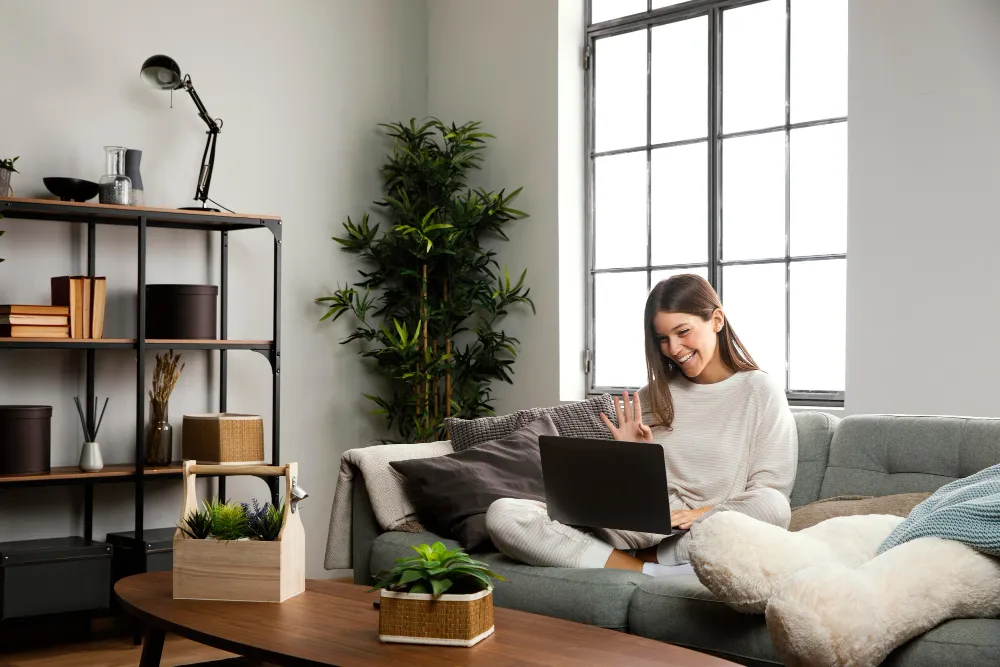
The demand for working from home is not only generation-dependent but also varies regionally. Large cities with a high density of tech, consulting, or creative industries, such as Berlin, Munich, Hamburg, and Cologne, record the highest share of job advertisements with a remote option. Competition for talent is particularly high there, which is why many companies use working from home specifically as a strategic advantage in hiring.
Gleichzeitig verdeutlichen die Zahlen des ifo Instituts und des ZEW, dass deutsche Unternehmen im internationalen Vergleich überdurchschnittlich stark auf Home-Office setzen. Laut ifo sind Beschäftigte in Deutschland häufiger im Home-Office als Arbeitnehmende in vielen anderen Ländern Europas. Und trotz Diskussionen um Büropräsenz für eine höhere Büroauslastung, planen laut ZEW nur wenige Unternehmen eine komplette Abkehr vom Home-Office. Im Gegenteil: Die meisten bleiben bei hybriden Modellen oder bauen dieses weiter aus.
Für Unternehmen bedeutet das: Wer regional um Fachkräfte konkurriert, kommt an Remote- und Hybrid-Optionen kaum vorbei. Home-Office ist längst kein „Nice-to-Have“ mehr, sondern eine erwartete Grundlage, um in Ballungsräumen attraktiv zu bleiben. Nicht zu vernachlässigen ist auch der Vorteil, dass kompetente Arbeitnehmende, die in ländlichen Regionen wohnen, gewonnen werden können.
Desk Sharing-Konzepte und flexible Flächennutzung ermöglichen es Arbeitgebern, diese neuen regionalen und demografischen Bedürfnisse optimal zu bedienen, ohne teure Leerflächen zu erzeugen. Die Verbindung aus ortsunabhängigem Arbeiten und intelligent gesteuerten Arbeitsplätzen im Büro stärkt die Wettbewerbsfähigkeit. Ganz egal, ob der Standort des Arbeitgebers urban oder ländlich situiert ist.
Fazit: Als Arbeitgeber den Zeitgeist nutzen – Home-Office strategisch denken und Büroauslastung optimieren
Alle aktuellen Studien, vom ifo, ZEW, Haufe „New Work Barometer“ bis zu XING zeigen ein eindeutiges Bild: Home-Office ist gekommen, um zu bleiben. Mitarbeitende erwarten Flexibilität, Arbeitgeber profitieren von mehr Attraktivität, größerem Talentpool und effizienteren Büroflächen.
Statt die Anwesenheitspflicht zum neuen Dogma zu machen, sollten Unternehmen den Fokus darauf legen, Büros bewusst zu gestalten und nicht krampfhaft zu füllen. Ein intelligenter Mix aus Home Office und modernen Arbeitsplätzen im Büro schafft ein Umfeld, das sowohl Produktivität als auch Zufriedenheit steigert.
Mit Lösungen wie Desk Booking Tools können Flächen bedarfsgerecht genutzt, Kosten reduziert und Mitarbeitenden gleichzeitig mehr Unabhängigkeit und Autonomie geboten werden. So wird das Büro wieder zu einem Ort, an dem sich Teams gerne treffen und das nicht, weil sie müssen, sondern weil es Mehrwert stiftet.
Unternehmen, die den Zeitgeist verstehen und darauf reagieren, sichern sich langfristig einen Vorteil im Employer Branding, sparsame Flächenkosten und eine moderne Arbeitskultur, die Talente anzieht und hält. Home-Office ist dabei kein Störfaktor, sondern ein entscheidender Erfolgsfaktor für die Zukunft der Arbeit und die dauerhafte Attraktivität des Arbeitgebers.
The most important questions summarized
What are the key findings of current studies on productivity in the home office?

The data clearly shows that working from home does not reduce productivity—quite the opposite. Many studies confirm that focused work at home is often more efficient, as distractions in open-plan offices are eliminated. However, the mix is crucial. While individual tasks flourish at home, creative processes and onboarding new colleagues benefit massively from being on-site. Hybrid work thus combines the best of both worlds and ensures a balanced performance record within the company.
Why is the freedom to choose one's workplace so important for employee retention according to studies?
Current surveys make it clear: flexibility is now a top criterion for professionals when choosing an employer. Many employees are even willing to change jobs if strict mandatory office attendance is introduced. The autonomy to choose a workplace that suits both tasks and personal life increases job satisfaction and mental well-being. Companies that rely on hybrid models thus position themselves as an attractive employer brand and sustainably strengthen the loyalty of their teams.
What role does the physical office still play for companies according to current trends?
The office is transforming from a mere place of work into a social "magnet." Studies show that the demand for fixed desks is falling, while the desire for collaboration areas and social meeting zones is rising. In 2026, the office serves primarily for team building, cultural exchange, and complex problem-solving. Strategic desk sharing helps to manage these changing space requirements, optimize costs, and make the remaining space so attractive that employees are happy to return voluntarily.
Last updated:
2026-10-12
.svg)