Workplace Management
2026-07-31
Room management with Outlook: How Flexopus complements the hybrid office
While Outlook is well-suited for traditional room booking, it reaches its limits in a hybrid office environment. Flexopus expands room management to include workstations, parking spaces, catering, and other resources. Thanks to a bidirectional Exchange integration, bookings remain synchronized across Outlook and Flexopus, effectively preventing double bookings.

Table of contents
Microsoft Outlook is the primary scheduling tool for many companies. Beyond managing attendees and calendars, it can also be used to organize meeting rooms and other resources. Employees can select an available room and add it to the invitation directly while creating a meeting.
However, traditional room management with Outlook quickly reaches its limits in a hybrid office. Modern companies need to manage not only meeting rooms but also coordinate flexible workspaces, parking spots, and other company assets.
Flexopus therefore combines familiar Outlook room booking with a centralized workplace management solution. Thanks to the Microsoft Exchange integration bookings remain bi-directionally synchronized between Outlook and Flexopus. At the same time, employees can also use Flexopus to organize desk sharing and other shared resources.
What is room management with Outlook?
With room management in Outlook, meeting rooms are set up as resources in Microsoft Exchange Online or on-premises. Each room is assigned its own resource mailbox and an associated resource calendar.
If a user wants to book an Outlook room, they first create an appointment or meeting. They can then add the required attendees and an available room.
The resource mailbox processes the meeting request much like an invited person. It checks whether the requested time slot is available and whether the defined booking options are met. If the room is free, the reservation is confirmed. If it is already booked, the request can be automatically declined. Depending on the Microsoft configuration, meeting rooms can be filtered by location, building, capacity, or equipment.
Companies can define rules such as:
- maximum booking duration
- advance reservation limits
- automatic confirmation or rejection
- approval by a delegate
- permitted recurring bookings
- restrictions for specific individuals or teams
- consideration of capacity and equipment
Why Outlook alone is not enough for hybrid offices
Traditional room management with Outlook focuses on calendars and appointments. However, for a modern desk sharing concept, companies need to manage significantly more resources.
These resources cannot be effectively organized using individual Outlook calendars. With many workstations, each desk would require its own mailbox or a separate calendar. This would be complicated for users to navigate and burdensome for IT to manage.
Furthermore, Outlook primarily displays rooms in lists. Employees often cannot see at a glance where a room is located, which workstations are nearby, or how a floor is laid out.
This is exactly where Flexopus comes in.
Flexopus combines room booking and desk sharing
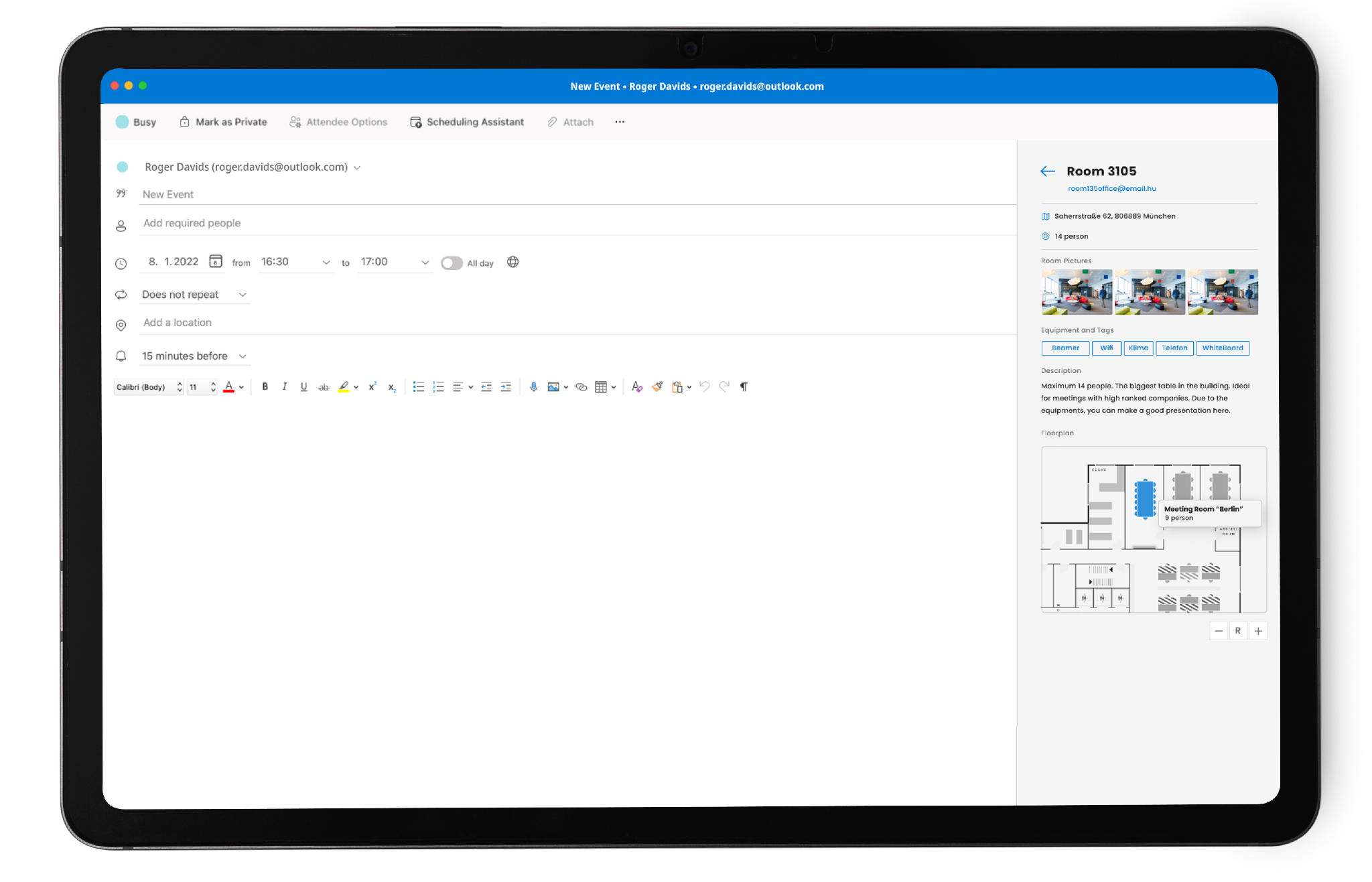
Flexopus is a workplace management solution for booking workstations, meeting rooms, and parking spaces. All resources are displayed on interactive building and floor plans.
Users first select the desired time frame and location. They can then see on the floor plan which workstations, rooms, or parking spaces are still available. Resources can also be filtered by features, equipment, or capacity.
In doing so, Flexopus combines room management with a complete desk sharing software. Users can book their most important office resources through a single application instead of using various calendars, lists, and booking systems.
Integrate Microsoft Exchange with Flexopus
Companies that already manage their meeting rooms via Outlook do not need to replace their existing process. Flexopus can be connected directly to Microsoft Exchange.
For Exchange Online, integration is handled via the Microsoft Graph API. The resource calendars for meeting rooms are linked to the corresponding rooms in Flexopus.
Synchronization works bidirectionally:
- A room booking created in Outlook automatically appears in Flexopus.
- A reservation created in Flexopus is transmitted to Microsoft Exchange.
- Changes and cancellations are reconciled between both systems.
- Microsoft Exchange remains the central authority for confirming a booking.
Since both solutions access the same resource calendar, the booking status remains consistent. A room booked via Outlook is also shown as occupied in Flexopus. Conversely, a booking made via Flexopus appears in the user's Outlook calendar. This prevents double bookings.
Manage catering and external guests directly via the Flexopus Outlook Add-in
The Flexopus Outlook add-in allows you to book not only meeting rooms, but also catering and facility services as well as include external guests directly when scheduling appointments. This allows additional services to be organized conveniently within your familiar Outlook workflow.
Depending on the Flexopus modules in use, users can, for example, do the following when creating a meeting:
- Order catering and refreshments for the appointment
- Add facility services and other support services
- Invite external guests and visitors directly to the meeting
- Collect relevant visitor data before the appointment
- Allow guests to check themselves in on-site
This consolidates room booking, scheduling, catering, and visitor management into a single process. Employees do not need to switch between different applications and can handle the most important organizational tasks related to a meeting directly from Outlook.

Combining Outlook and desk sharing effectively
Flexopus complements Outlook room management with additional features for the hybrid workday. In addition to meeting rooms, employees can also book desks and parking spaces, allowing them to plan their office day centrally.
Through iCal synchronization, personal Flexopus bookings can also be transferred to external calendars such as Microsoft Outlook. Booked desks, parking spaces, or other resources will then appear in your personal calendar, keeping them in view alongside your other appointments.
Optionally, Flexopus can also be synchronized with the Microsoft work location feature. If, for example, a desk or home office is booked in Flexopus, the corresponding work location can also be displayed in Microsoft 365 or Outlook. This makes it easier for colleagues to see whether someone is working in the office or remotely.
This creates a seamless process for companies:
- Desks and parking spaces are booked centrally via Flexopus.
- Personal bookings can be displayed in the Outlook calendar via iCal.
- Desk and home office bookings can be synchronized with the Microsoft work location.
- Meeting rooms are reserved via Outlook or Flexopus and synchronized via Exchange.
- All resources remain centrally manageable in Flexopus.
Benefits of the Flexopus Exchange integration
This is exactly where Flexopus comes in.
Flexopus connects room booking and desk sharing
The combination of Flexopus, Outlook, and Microsoft Exchange offers companies several advantages:
- existing Outlook processes are maintained
- room bookings are synchronized bidirectionally
- employees can use Outlook or Flexopus for booking
- interactive floor plans make navigation easier
- capacity and equipment are immediately visible
- double bookings are avoided
- workstations, rooms, and parking spaces are managed centrally
- desk sharing and room booking work hand in hand
- users without their own Microsoft 365 license can also book resources via Flexopus
- room displays, check-in, and usage analytics can be added
Conclusion: More than classic room management with Outlook
Room management with Outlook provides a solid foundation for booking meeting rooms via Microsoft Exchange. However, for hybrid companies with flexible workstations, parking spaces, and changing office attendance, it is often not enough.
Flexopus complements Outlook and Exchange with a central workplace management platform where rooms, workstations, parking spaces, and other office resources can be managed clearly.
The most important questions summarized
How does room management work with Outlook?

Meeting rooms are set up in Microsoft Exchange as resources with their own calendars. When scheduling an appointment in Outlook, an available room can be added directly. Exchange automatically checks availability and booking rules, then confirms or declines the reservation accordingly.
Why is Outlook often insufficient for hybrid offices?
Outlook is primarily designed for scheduling meetings and managing room calendars. However, hybrid offices also require the coordination of workstations, parking spaces, equipment, team proximity, check-ins, and other services. Managing these resources through individual calendars or mailboxes would be cumbersome, inefficient, and difficult to oversee.
How does Flexopus complement Outlook room management?
Flexopus connects Outlook and Microsoft Exchange with a centralized workplace management platform. Rooms, desks, and parking spaces can be booked via interactive floor plans. Room bookings are synchronized bidirectionally, ensuring that reservations remain consistent across both Outlook and Flexopus and preventing double bookings.
Last updated:
2026-07-31
.svg)


.webp)
.webp)